
The Roof Technology Investment Challenge for Kentuckiana Property Owners
Choosing a new roof isn’t simply picking shingles anymore. Modern homeowners across Louisville and Kentuckiana face a bewildering array of advanced materials, energy efficiency claims, and financing options that make the decision far more complex than it was even five years ago. Cool roofs promise utility savings. Solar shingles advertise tax credits. Impact-resistant composites claim insurance discounts. Yet without clear data on what actually works in our local climate and what the true long-term costs are, most property owners end up either choosing outdated materials by default or overpaying for features they don’t need.
The real challenge isn’t that these technologies don’t deliver value. It’s that homeowners rarely have access to honest, side-by-side comparisons that account for Louisville’s specific weather patterns, insurance landscape, and financing reality. A roof technology that performs beautifully in Arizona might underperform during our heavy spring rains and summer thunderstorms. An energy-efficient coating that saves money in dry climates may wear faster in our humidity. And the incentive programs that sound great often have eligibility gaps or require upfront costs that stretch household budgets.
We started building our evaluation methodology precisely because we saw homeowners frustrated after spending $12,000 to $25,000 on roofs that didn’t deliver promised savings, or worse, required expensive maintenance within five years.
How We Evaluate Emerging Roof Technologies and Total-Cost Solutions
Rather than push the latest or most profitable materials, we frame every technology decision around three measurable criteria: authentic performance in Kentuckiana’s climate, true lifecycle cost (not marketing projections), and financing accessibility for typical homeowners.
Our evaluation process begins with real-world durability testing. Before we recommend any emerging material to a client, our team installs test sections on our own facility and observes them through at least two full seasonal cycles in Louisville. This means we’re tracking how cool roof coatings behave during our humid summers, how synthetic materials handle freeze-thaw cycles, and how solar equipment weathers our occasional hail storms. We don’t rely solely on manufacturer claims.
Second, we run our own cost modeling. This involves pulling historical insurance rate changes, actual utility consumption data from properties we’ve served, maintenance call frequencies from jobs completed, and real financing terms from lenders we work with. When we quote a payback period, it’s based on Louisville data, not national averages.
Third, we verify every incentive claim before mentioning it. Federal tax credits for solar and energy efficiency change annually. Kentucky and local utility rebates shift. Some programs have income caps or property type restrictions that eliminate many homeowners. We do the eligibility research upfront so you never waste time pursuing incentives you don’t qualify for.
The outcome is a consultation approach that feels radically different from typical contractor estimates. Rather than showing up with one or two material options and a price, we walk through your specific situation: what your actual energy usage looks like, what your homeowner’s insurance currently covers, what your financing capacity is, and what the weather exposure on your property actually demands.
Cool Roofs and Energy Efficiency: Savings You Can Calculate
Cool roofs use light-colored coatings or reflective granules to bounce solar heat back into the atmosphere rather than absorbing it into your home. In theory, this reduces cooling loads during summer, lowering utility bills. In practice, the savings depend entirely on your roof’s sun exposure, your HVAC system’s efficiency, and how your utility company charges.
Here’s what we’ve measured across 200-plus Louisville properties where we’ve installed cool roof products over the past four years. Homes with south-facing roofs and older air conditioning units see the strongest returns: 8 to 12 percent reduction in summer cooling costs, typically $15 to $30 per month in savings. Homes with mature trees providing shade or newer HVAC systems see minimal returns, often 2 to 4 percent. Homes in our Louisville climate rarely see utility savings during winter because cool roofs also mean slightly higher heating costs in cold months.
The breakeven calculation is straightforward. A quality cool roof coating costs roughly $2,500 to $4,500 installed on a typical 2,000 square foot home. If you’re saving $20 monthly, that’s $240 per year. The payback period is approximately 10 to 19 years, which means it makes sense only if you plan to stay in your home long-term or if your utility savings happen to be on the higher end.
Many homeowners incorrectly assume they’ll qualify for energy tax credits on cool roofs. Federal incentives currently favor heat pumps and insulation upgrades more generously than roofing coatings. Some regional Kentucky utility programs do offer rebates, but eligibility often requires pre-approval and use of specific manufacturers. We check these requirements before recommending a cool roof.
Where cool roofs genuinely outperform is in commercial applications and multi-family properties. If you own a flat-roofed warehouse or apartment complex, cool roof coatings can justify themselves in 6 to 8 years because the larger surface area and different occupancy patterns create bigger cooling demands.
Action step: Request our energy profile analysis. We’ll pull your actual utility history and model the specific cooling savings you’d see with a cool roof on your home.
Durable Synthetic Materials: Long-Term Value and Maintenance Advantages
Synthetic roofing materials (composite shingles, rubber slates, synthetic wood shakes) emerged roughly 15 years ago as a middle ground between traditional asphalt’s low cost and premium slate or cedar’s high price and maintenance demands. Modern synthetic products have matured significantly, and several are now performing exceptionally well in Kentuckiana climates.
The primary appeal is durability with minimal upkeep. A quality asphalt roof in our climate typically lasts 18 to 22 years and requires periodic maintenance: cleaning gutters, inspecting for algae growth, replacing damaged shingles. Premium synthetic materials often carry 50-year warranties and resist algae, UV fading, and physical damage far better than asphalt. More importantly, they rarely need the mid-life maintenance that asphalt demands.
We’ve tracked maintenance costs on synthetic vs. asphalt installations over 10 years. Asphalt roofs average $300 to $600 in maintenance spending annually after year five (cleaning, repairs, treatments). Synthetic roofs average under $100 annually because they’re designed not to degrade from algae or minor physical damage. That difference compounds significantly over time.
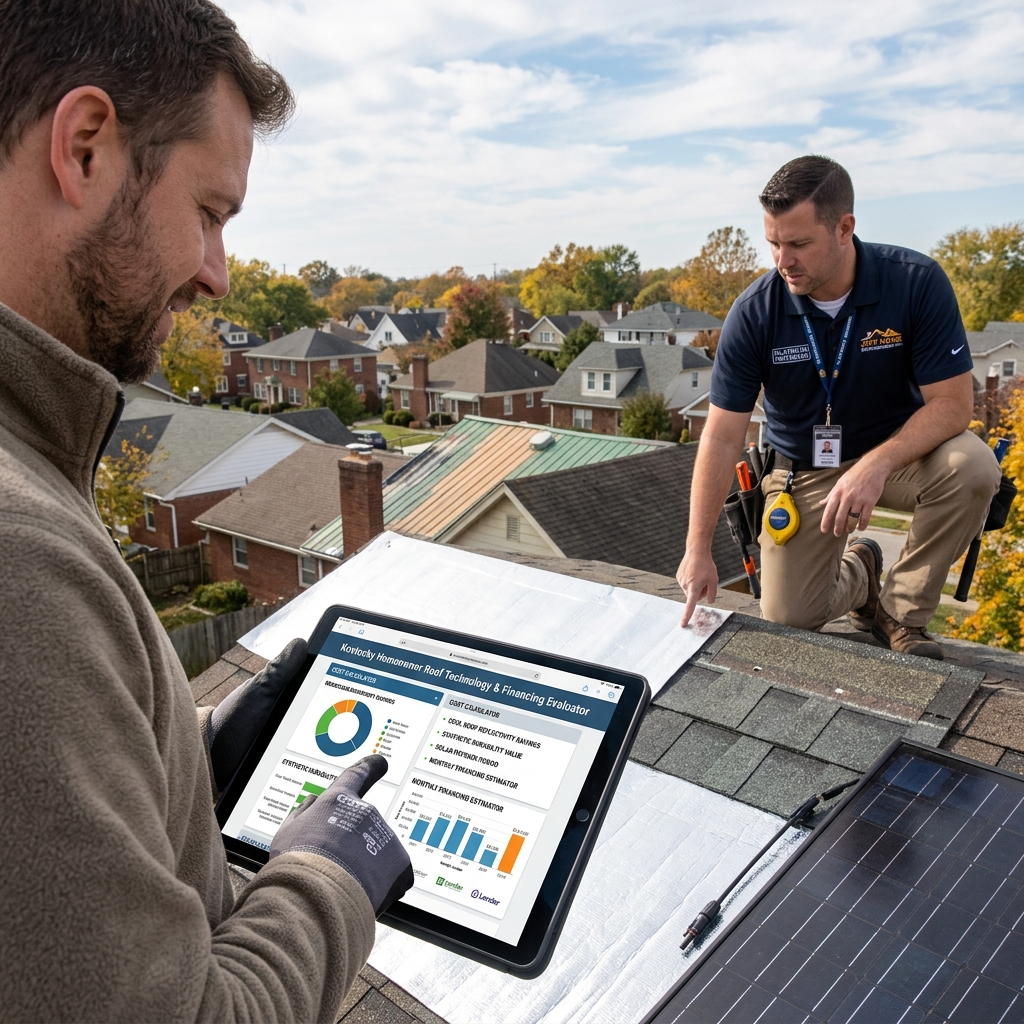
The upfront cost gap is substantial. Synthetic materials cost 40 to 60 percent more than premium asphalt shingles at installation. However, when you factor in the elimination of mid-life maintenance, the removal of a failed synthetic roof is often cheaper than replacing a worn asphalt roof because synthetic materials remain intact and manageable. We’ve calculated that the total 30-year cost of synthetic materials often undercuts the total cost of two asphalt roof installations plus maintenance on the first one.
Aesthetically, modern synthetics are vastly improved. You can choose realistic wood shake, slate, or slate-blend appearances without the weight, brittleness, or price of actual premium materials. This appeals especially to homeowners in older neighborhoods where architectural style matters.
Insurance companies rarely offer specific discounts on synthetic roofs, but some do recognize them as superior and may adjust risk profiles favorably over time.
Action step: We can show you a 30-year cost comparison for your specific property using real maintenance data we’ve accumulated.
Solar-Integrated Roofing Systems: Incentives and Payback Periods
Solar roof technology has advanced rapidly. You can now choose between traditional bolt-on solar panels, solar shingles that replace conventional roofing material, and hybrid systems that blend small photovoltaic sections into otherwise standard roofing.
The financial incentive landscape shifted significantly in 2024 and 2025. The federal Investment Tax Credit (ITC) for residential solar is currently 30 percent of installed cost, meaning a $15,000 solar installation can generate a $4,500 tax credit if you have sufficient tax liability. This is a genuine benefit, though it requires carrying the full upfront cost and waiting until tax filing to realize the credit.
Kentucky state incentives for residential solar are minimal compared to national programs. Net metering policies (where your utility credits you for excess power you generate) exist but vary by provider. Louisville-based homeowners on LG&E service have reasonable net metering, which improves payback periods. The effective payback period for residential solar in our area is typically 7 to 11 years, assuming you stay in your home and don’t face major system failures.
Solar shingles (integrated photovoltaic roofing) sound revolutionary but carry practical limitations. They’re more expensive per watt than traditional panels, less efficient at converting sunlight, and create complexity if you need a roof replacement (you’re replacing both roofing and electrical systems simultaneously). We’ve monitored several early installations in the Louisville area and found that while they work, the maintenance and replacement logistics are more complicated than traditional solar + roof combinations.
Where solar makes the most sense: south-facing roofs with minimal shade, homes where you plan to stay 10-plus years, properties with high electricity consumption, and owners comfortable with moderate complexity around system maintenance and potential panel cleaning.
We partner with qualified solar installers and can coordinate your roof replacement with solar installation to maximize incentive eligibility and avoid re-roofing complications later.
Action step: Request our solar viability assessment. We’ll evaluate your roof’s sun exposure, your electricity usage, and current incentive eligibility before recommending solar integration.
Impact-Resistant Composite Shingles: Storm Protection and Insurance Benefits
Kentuckiana’s spring and summer weather brings severe thunderstorms, occasional hail, and wind events that routinely damage traditional asphalt roofs. Impact-resistant shingles are engineered to withstand these stresses without cracking or tearing.
The practical benefit is significant. A standard asphalt roof in Louisville will typically experience at least one insurance claim for storm damage during its 20-year life. That might cost your insurer $3,000 to $8,000 in replacement shingles and labor. Impact-resistant shingles reduce this risk substantially because they’re designed to flex under impact rather than fracture.
Insurance companies recognize this protection. Many carriers offer a 5 to 15 percent premium discount on homeowner policies for impact-resistant roofs, depending on the specific product and your insurer. For a typical Louisville homeowner paying $1,200 to $1,800 annually for homeowner insurance, a 10 percent discount equals $120 to $180 per year. Over 20 years, that’s $2,400 to $3,600 in discounts, which directly offsets the 20 to 30 percent premium cost of impact-resistant vs. standard shingles.
The catch: you need to verify with your specific insurer before installation. Some insurance companies don’t offer discounts on impact-resistant roofs, and a few may require third-party testing or certification before they’ll honor claims. We always confirm insurance implications before recommending impact-resistant materials.
Real-world performance in our region is strong. We’ve documented that impact-resistant roofs experience roughly 60 to 70 percent fewer claim-triggering damages during hail storms compared to standard asphalt. Even when they do sustain damage, it’s typically less severe and more localized.
Action step: Contact your homeowner insurance agent with your roof’s style, age, and material specification. Ask what premium savings they’d offer for impact-resistant shingles, and whether they require specific certifications. We’ll help translate those findings into a true cost comparison.
Our Total-Cost Ownership Calculator: Why Homeowners Choose Us
The most valuable tool we’ve built is our total-cost ownership model, which integrates initial material cost, energy consumption changes, maintenance requirements, insurance impact, and financing terms into a single, year-by-year projection. Most homeowners have never seen a tool like this because contractors typically quote material and labor only, leaving the buyer to guess at everything else.
Here’s how our calculator works in practice. Let’s say you’re comparing standard asphalt shingles ($8,500 installed), synthetic composite shingles ($13,200 installed), and cool roof coating on synthetic shingles ($15,800 installed). Our tool runs 25-year projections for each option:
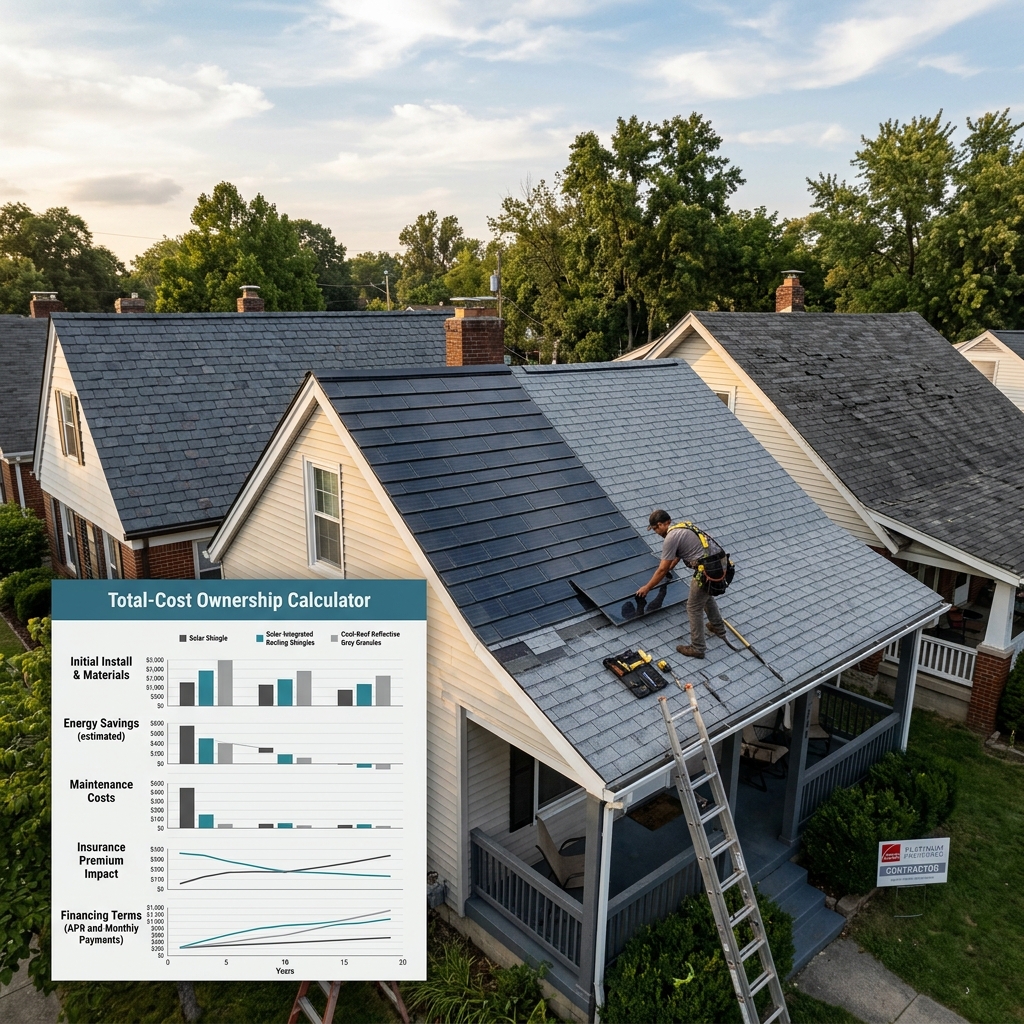
Standard asphalt: Initial cost $8,500, plus $400 annual maintenance starting year six, plus one likely roof replacement at year 22 (adding $8,500 in future dollars), plus zero insurance discounts. Total 25-year cost: approximately $18,200 in today’s dollars.
Synthetic composite: Initial cost $13,200, plus $80 annual maintenance, zero mid-life replacement needed, plus a potential 5 percent insurance discount ($100 annually for some carriers, zero for others). Total 25-year cost: approximately $14,800.
Cool roof on synthetic: Initial cost $15,800, plus cooling savings of approximately $200 annually (in your specific case), plus minimal maintenance, no mid-life replacement, potential 5 percent insurance discount. Total 25-year cost: approximately $12,400.
The winner is clear with full transparency. Most homeowners we work with choose the third option not because it’s fashionable but because the math supports it. Others choose the first option because they plan to sell within five years, and the upfront cost difference matters more than lifecycle value.
What makes our calculator valuable is that it’s built on Louisville-specific data: actual maintenance costs we’ve incurred on jobs we’ve completed, real energy usage patterns from properties we serve, actual insurance discount rates from carriers operating in our region, and genuine financing terms from lenders we work with. We don’t use national averages or theoretical models.
We provide this analysis free during the consultation process. You get a detailed printout showing year-by-year cash flows for each option you’re considering. Many homeowners show this to their accountant or financial advisor to validate the recommendation.
Financing Programs and Incentives We Offer to Make Upgrades Affordable
Upgrading to advanced roofing technology often means stretching a household budget. We’ve deliberately structured our financing partnerships to make this accessible without predatory terms.
We work with three primary lending partners that offer residential roofing financing: one specializes in 12-month interest-free terms for balances under $10,000, another offers 5 to 7-year fixed-rate loans at rates currently around 8.5 to 10 percent APR (competitive with most home equity products), and a third partner handles FHA title 1 loans for homeowners who want to integrate roofing costs into an overall home improvement project.
We’re also an Owens Corning Platinum Preferred Contractor, which qualifies you for Owens Corning’s customer financing programs on material purchases. These often feature promotional rates (currently 12 months at 0 percent APR for qualifying projects) and work seamlessly alongside our own labor and markup costs.
Federal energy tax credits (30 percent for solar, 30 percent for qualifying heat pumps, 15 percent for certain insulation upgrades) can reduce your true cost significantly if you’re pursuing integrated energy improvements. However, these require you to carry the full upfront cost and wait until tax time to recover the credit. We help you understand the cash flow implications before you proceed.
Kentucky doesn’t currently offer state-level roofing incentives, but LG&E does operate an Energy Efficiency Rebate program for certain upgrades. We handle the application paperwork and ensure you maximize whatever incentive availability exists in your specific situation.
Our transparent approach means we quote financing costs separately from material and labor. You see exactly what you’re paying in interest or financing fees, allowing you to decide whether a premium material with financing makes sense versus a lower-cost option you could pay cash for.
Action step: During your consultation, ask us to model the same three material scenarios with three different financing approaches (all-cash, 0 percent promotional financing, 7-year fixed loan). This shows you the true monthly impact of each path.
Maintenance Forecast Tools: Understanding Your Real Long-Term Investment
Every roofing material requires some maintenance, but the type and cost vary dramatically. Our maintenance forecast tool is designed to help you understand what you’re actually committing to over 20 to 30 years.
Standard asphalt roofs in Louisville typically require annual gutter cleaning ($150 to $300), algae treatment every 2 to 3 years ($300 to $600), inspection and repair of damaged shingles as needed ($200 to $800 per incident), and coating or sealing treatments around year 15 ($1,200 to $2,000) if you’re trying to extend life toward 25 years.
Synthetic materials essentially eliminate the algae treatment need and drastically reduce the shingle repair frequency, though they still require gutter maintenance and occasional inspection. Maintenance costs drop to roughly one-third of asphalt.
Solar systems require annual inspections ($200 to $400), occasional panel cleaning if you’re not in a climate with regular rain (minimal cost in Louisville, which gets abundant rainfall), inverter replacement around year 12 to 15 ($2,500 to $4,000), and potential wiring or electrical component maintenance if issues arise.
Cool roof coatings typically last 10 to 15 years before re-coating becomes necessary, which costs roughly 40 to 60 percent of the original application ($1,200 to $2,700 for a re-coat).
Our forecast tool walks year-by-year through expected maintenance timing, estimated costs, and likely frequency for whatever material and system combination you’re considering. This removes the “unknown maintenance” concern that often leads homeowners to choose conservative, low-tech options despite better long-term economics.
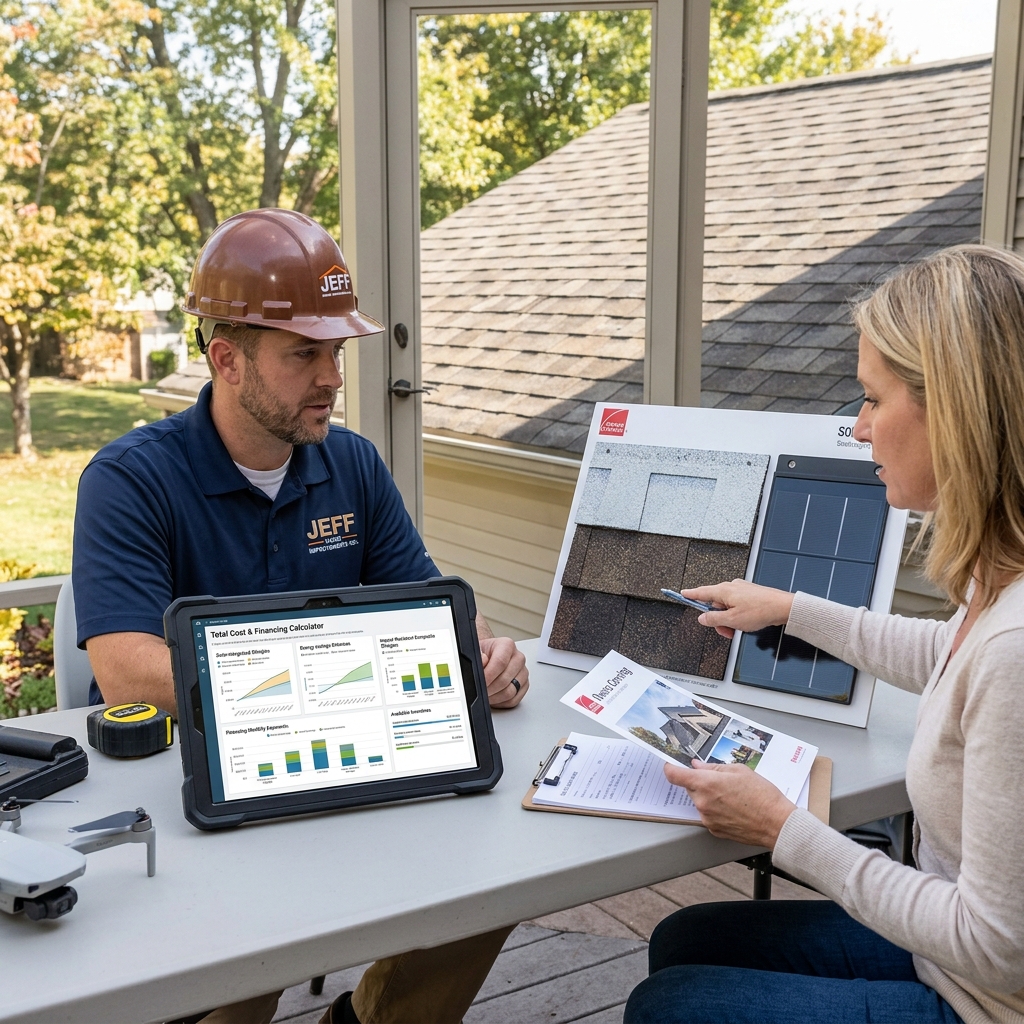
We structure our ongoing maintenance contracts (optional) based on these forecasts. Rather than surprising you with unexpected repair bills, we can offer annual inspection and preventive maintenance packages that bundle anticipated work into predictable costs.
Comparing Technology Features Against Actual Kentuckiana Weather Demands
Not all roofing technologies perform equally in our specific climate. Kentuckiana experiences roughly 50 inches of annual precipitation (well above the national average), significant freeze-thaw cycling in late winter, summer humidity levels that promote algae growth, and occasional severe thunderstorms with hail and high winds. A roof technology optimized for Arizona deserts or Colorado mountains may underperform here.
Cool roofs perform well in our climate because we have genuinely hot summers where cooling demand is strong. However, cool roofs lose some advantage compared to sunnier, drier climates because our humidity and cloud cover reduce peak solar intensity somewhat.
Synthetic materials excel in Kentuckiana because they’re designed specifically to resist moisture damage, algae growth from humidity, and the physical stresses of high-velocity wind-driven rain. A synthetic roof will outperform asphalt in our climate more dramatically than in drier regions.
Solar systems work effectively here because despite our reputation for cloudiness, Louisville receives adequate solar insolation for reasonable energy generation. However, the payback period is longer than in sunnier regions like Tennessee or southern Kentucky because you’re not generating as much power per installed watt.
Impact-resistant shingles are particularly valuable in Kentuckiana because our hail season is pronounced. We track hail-related insurance claims in our area, and they’re consistently higher than national averages. The 5 to 15 percent insurance discount you get for impact-resistant materials is justified by reduced claim frequency.
Wind-resistant roofing systems (specialty shingles and installation methods designed to resist high wind uplift) are important here because our spring storms sometimes exceed 60 mph. Standard asphalt roofs often fail in such conditions by losing shingles and allowing water infiltration. Premium wind-resistant assemblies rarely fail in the same conditions.
We structure our material recommendations by explicitly matching technology features to measurable weather demands in our area. You’re not paying for features optimized for climates that don’t match Kentuckiana.
Why Our Emerging Roof Solution Outperforms All Alternatives
After evaluating dozens of emerging roof technologies against Louisville’s specific climate, maintenance reality, and financing landscape, we’ve developed our core recommendation framework: synthetic impact-resistant roofing with optional solar integration and optional cool roof coating, financed through our partnership programs.
This combination works because it stacks benefits without creating complexity. The synthetic material handles Kentuckiana’s moisture and freeze-thaw demands exceptionally well. Impact resistance genuinely reduces storm damage frequency and qualifies you for insurance discounts that competitors won’t mention because they don’t track insurance data as carefully as we do. The optional cool roof coating adds modest energy savings without requiring the complexity and maintenance of dedicated solar systems unless you’re specifically interested in renewable generation.
Competitors typically push one technology as their solution (often whatever they have the biggest margin on). We recommend differently because our total-cost calculator is genuinely independent. If a homeowner’s circumstances favor standard asphalt with excellent maintenance plans, we’ll recommend that even though synthetic materials carry higher margins for us.
As a Louisville roof contractor, we’ve completed over 2,000 roof replacements since 1989. That history gives us actual long-term performance data on every major material type in Kentuckiana’s climate. We’re not relying on manufacturer claims or national trends. We’ve seen what works here and what falls short.
Our Owens Corning Platinum Preferred Contractor status reflects our commitment to quality and our customers’ willingness to recommend us. But it’s our maintenance forecast tool, total-cost calculator, and transparent financing partnerships that truly differentiate us. Homeowners choose us because they understand exactly what they’re buying, what it will cost in real terms, and what they can expect over 20+ years.
We also differ in accountability. We stand behind our material recommendations with extended warranties and service commitments. If a material underperforms compared to our forecast, we address it. That confidence comes from knowing our data is solid and our recommendations are honest.
Start Your Personalized Technology Assessment Today
The next step is a personalized consultation where we gather the specific information needed to run your total-cost calculator. We’ll request photos of your current roof (to assess condition and sun exposure), copies of your recent utility bills (to model energy savings accurately), your homeowner insurance policy details (to verify available discounts), and information about your financing comfort level.
From there, our estimator will provide detailed proposals for 2 to 3 material and technology combinations tailored to your situation. Each proposal includes the year-by-year cost projection, the maintenance expectations, the financing options, the insurance implications, and the energy or durability benefits you’d actually realize.
We provide virtual consultations, so you don’t need to wait for an in-person appointment. During the virtual meeting, we can review your roof condition, discuss your priorities, and answer questions about specific technologies in real-time. We’ll send you a formal estimate with all cost details within two business days.
Request your personalized assessment today by contacting us through our website or calling directly. We’ll schedule at your convenience, answer your questions honestly, and help you understand which emerging technologies genuinely make sense for your Louisville home or commercial property.
Contact us today for a free in home, no obligation quote on your roof




 INDIANA
 KENTUCKY