
Understanding the Cost of Roofing Downtime for Your Business
Commercial roof replacement is one of those necessary investments that every building owner dreads. You know the work has to happen, but the thought of noise, debris, restricted access, and potential interruptions to daily operations can make you hesitate. The good news: with the right strategy and contractor partner, you can keep your business running smoothly while your roof gets the attention it needs.
At Jeff Home Improvements Inc., we’ve helped Kentuckiana business owners and commercial managers navigate commercial roof replacements for nearly four decades. We understand that your bottom line depends on keeping operations intact. That’s why we’ve developed proven strategies to minimize disruption while delivering the quality your building deserves.
When we talk to commercial clients, many focus only on the material and labor costs of roof replacement. They often overlook the real expense: lost productivity and operational disruption.
Consider a mid-sized office building. If roof work forces you to relocate staff, lose HVAC access due to roofing activity, or deal with noise that disrupts client meetings, the costs add up quickly. A retail space losing customer foot traffic during renovation week. A warehouse unable to receive shipments while heavy equipment operates on the roof. A professional services firm dealing with uncomfortable working conditions that affect employee morale.
The financial impact includes:
- Lost revenue from reduced capacity or customer avoidance
- Employee productivity loss due to noise, heat, or displacement
- Potential overtime costs if staff must work shifted hours
- Client dissatisfaction and reputational risk
- Emergency response costs if unexpected issues arise mid-project
Research in the commercial real estate sector shows that every day of operational disruption can cost small to mid-sized businesses anywhere from $500 to $5,000, depending on the operation type. For a two-week roof replacement without proper planning, that’s a significant hidden expense layered on top of the actual roof investment.
The real question isn’t “How much does this roof cost?” It’s “How much does this roof cost if we lose two weeks of normal operations?” Once you frame it that way, the value of planning becomes crystal clear.
Why Professional Planning Prevents Operational Disruption
The difference between a smoothly executed roof replacement and a chaotic one almost always comes down to planning before the first nail is hammered.
We’ve observed a pattern over the years: contractors who rush into projects without detailed site planning create unnecessary friction. They haven’t identified rooftop access points, evaluated traffic patterns, communicated with building occupants, or built flexibility into their timeline. The result? Surprises emerge daily, timelines slip, and your business absorbs the impact.
Professional planning addresses the core question: “How do we complete this work efficiently while keeping your building operational?”
This requires several elements working together:
- Site assessment before scheduling: We evaluate your roof, building layout, access points, and surrounding operations to identify potential friction points.
- Customized project sequencing: Rather than applying a one-size-fits-all approach, we structure the work around your specific business needs.
- Clear timeline expectations: You know exactly when noise will occur, when access will be limited, and when normal operations resume.
- Contingency buffers: Weather happens. Unexpected structural issues surface. Professional planners build realistic schedules that account for variables.
- Communication infrastructure: Regular updates keep your team aligned and prevent surprises.
When we plan a roof replacement, we’re not just scheduling work days. We’re designing the entire project to protect your business continuity. That’s the distinction between standard contractors and partners who understand commercial operations.
Strategy 1: Phased Roofing Approach for Continued Operations
Many building owners assume roof replacement must happen all at once, resulting in maximum disruption for a fixed period. That’s not always the case, and we often recommend breaking the work into phases.
Here’s how phased roofing works in practice: Rather than replacing the entire roof simultaneously, we section the building into zones. We complete one zone fully before moving to the next, allowing normal operations to resume in completed sections while work continues elsewhere.
For a 40,000-square-foot commercial building, that might look like this:
- Phase 1 (Week 1-2): East section of roof. West side operations continue normally; minimal noise in main building areas.
- Phase 2 (Week 3-4): North section. East section now protected; North-facing offices experience activity, but two-thirds of building unaffected.
- Phase 3 (Week 5-6): West and south sections complete the project.
This approach delivers several advantages:
- Staged financial investment: You’re not paying the full project cost upfront; invoicing aligns with completed phases.
- Reduced operational impact: At any given time, only one building section experiences active work.
- Easier staff coordination: Employees know which week their area will be affected and can plan accordingly.
- Quality assurance: Completing one phase fully before moving on allows us to inspect and address any issues before moving the crew.
- Revenue continuity: For retail or hospitality operations, customer-facing areas can remain operational throughout most of the project.
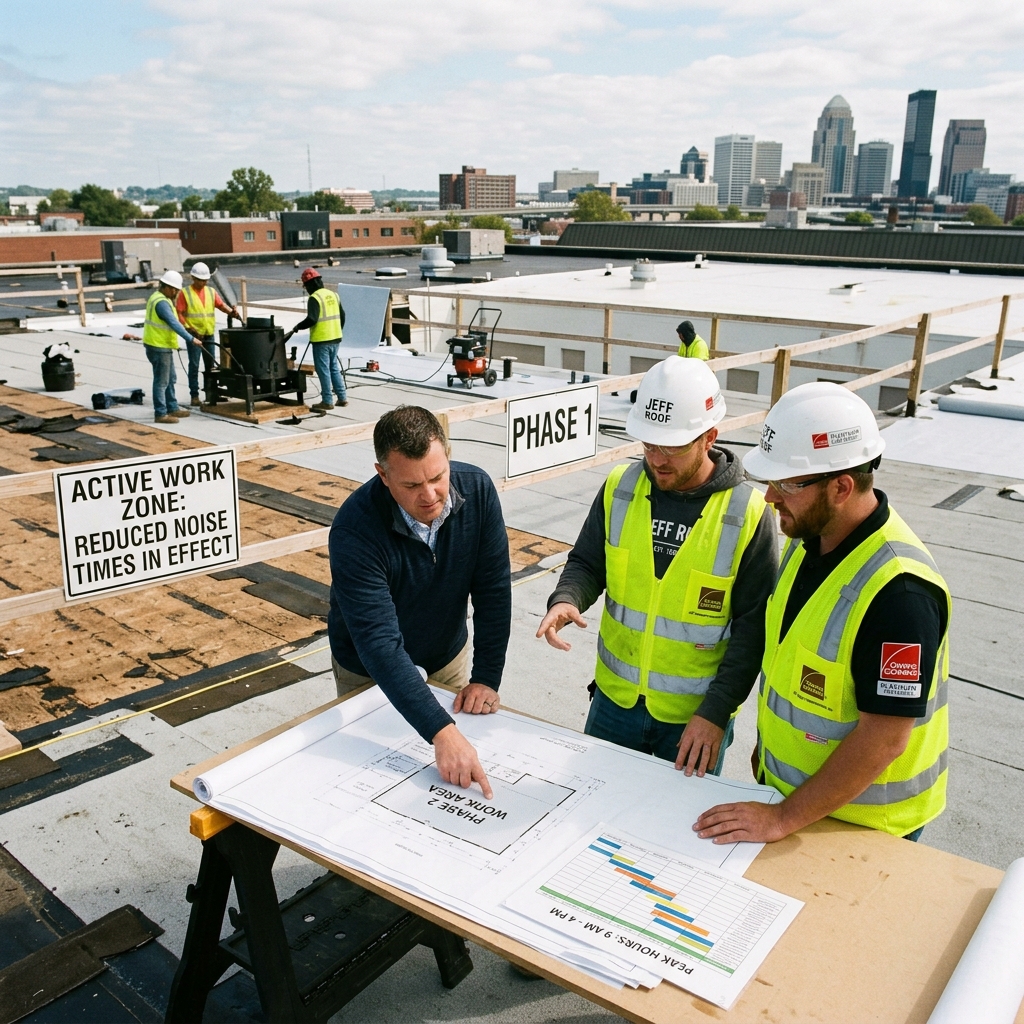
The trade-off: phased work typically extends the overall timeline by 2-4 weeks compared to a single mobilization. For most commercial operations, that’s a worthwhile exchange for reduced disruption. Not every building is a candidate for phasing (very small roofs, for instance, might finish faster as one project), but discussing this option during planning often reveals it’s the better path.
Strategy 2: Scheduling Around Your Peak Business Hours
Timing isn’t just about picking a convenient month. It’s about aligning roofing activity with your lowest-traffic hours.
A professional services firm’s traffic peaks mid-morning and early afternoon. Roofing crews should start before dawn and focus on the loudest work during lunch hours and late afternoon. A retail location sees customer flow increase after 10 a.m.; early morning work with noise-mitigation measures during opening hours makes sense.
We work with your team to map your actual operational rhythm. This isn’t about assumptions. We ask:
- When does customer traffic peak?
- When are employee focus hours critical?
- Are there specific days (Friday drop-off, Monday startup) that are off-limits?
- Do you have seasonal fluctuations?
- Are there client presentations or events scheduled during the project window?
Once we understand your rhythm, we schedule accordingly:
- Loud work phases (tear-off, debris removal, structural repairs) cluster during lower-traffic windows.
- Quieter phases (material installation, finishing) can flex during normal hours.
- Crew arrival and departure schedule avoids your peak congestion times.
- Material delivery times prevent parking lot complications.
A manufacturing facility we worked with in Louisville had strict shift changes at 6 a.m., 2 p.m., and 10 p.m. We scheduled our noisiest roofing work between 9 a.m. and 1 p.m., in the window after first shift ended and before second shift peaked. The two-week project was barely noticed by production teams.
Strategic scheduling requires flexibility and real coordination, not just project management software entries. It’s the difference between a contractor who fits your building into their schedule and a partner who fits the project to your operations.
Strategy 3: Coordinated Communication and Employee Preparation
Disruption isn’t just physical. Uncertainty and lack of communication amplify the experience of disruption.
An unprepared staff dealing with unexpected noise, restricted hallway access, or surprise access points experiences far more disruption than a prepared staff dealing with identical conditions. Communication transforms chaos into managed expectations.
Our process includes:
- Pre-project briefing with your team: We meet with facility managers, department heads, or employee representatives to walk through what will happen, when, and what we’ll need from them.
- Detailed information packets: We provide written schedules, contact information, access instructions, and emergency protocols for your team to review and share.
- Weekly updates during active work: Regular check-ins keep you informed of progress, any changes to the schedule, and upcoming milestones.
- Dedicated project contact: Your team has one primary contact for questions or concerns, not a rotating roster of sub-contractors.
- Noise mitigation explanations: We explain why certain phases require noise, how long they’ll last, and what we’re doing to minimize impact.
Consider how differently employees experience a week when they’ve been told “Thursday will be loud due to old roofing tear-off, 8 a.m. to 4 p.m., then we’ll switch to quiet installation work,” versus a week where they simply hear unexpected hammering with no context.
Small operational details matter too. We coordinate:
- Where crews enter and exit (not through your main lobby)
- Parking arrangements for our vehicles and material deliveries
- Restroom access for our crew
- Weather contingency communication
- Safety protocols for your team if rooftop access is involved
This level of coordination prevents the day-to-day friction that turns a project into an unwelcome intrusion. Your team isn’t scrambling to accommodate us; we’ve already accommodated them.
Strategy 4: Weather-Dependent Project Timing and Flexibility
Kentucky weather is unpredictable. We can’t control it, but we can plan around it intelligently.
A roofing project impacted by rain or extreme heat costs more than scheduled. Bad weather forces:
- Work stoppages (you can’t install certain roofing materials in rain or extreme heat)
- Extended timelines (the project stretches from two weeks to three or four)
- Crew sitting idle or returning multiple times (driving labor costs)
- Uncertainty for your business (unclear when the project actually ends)
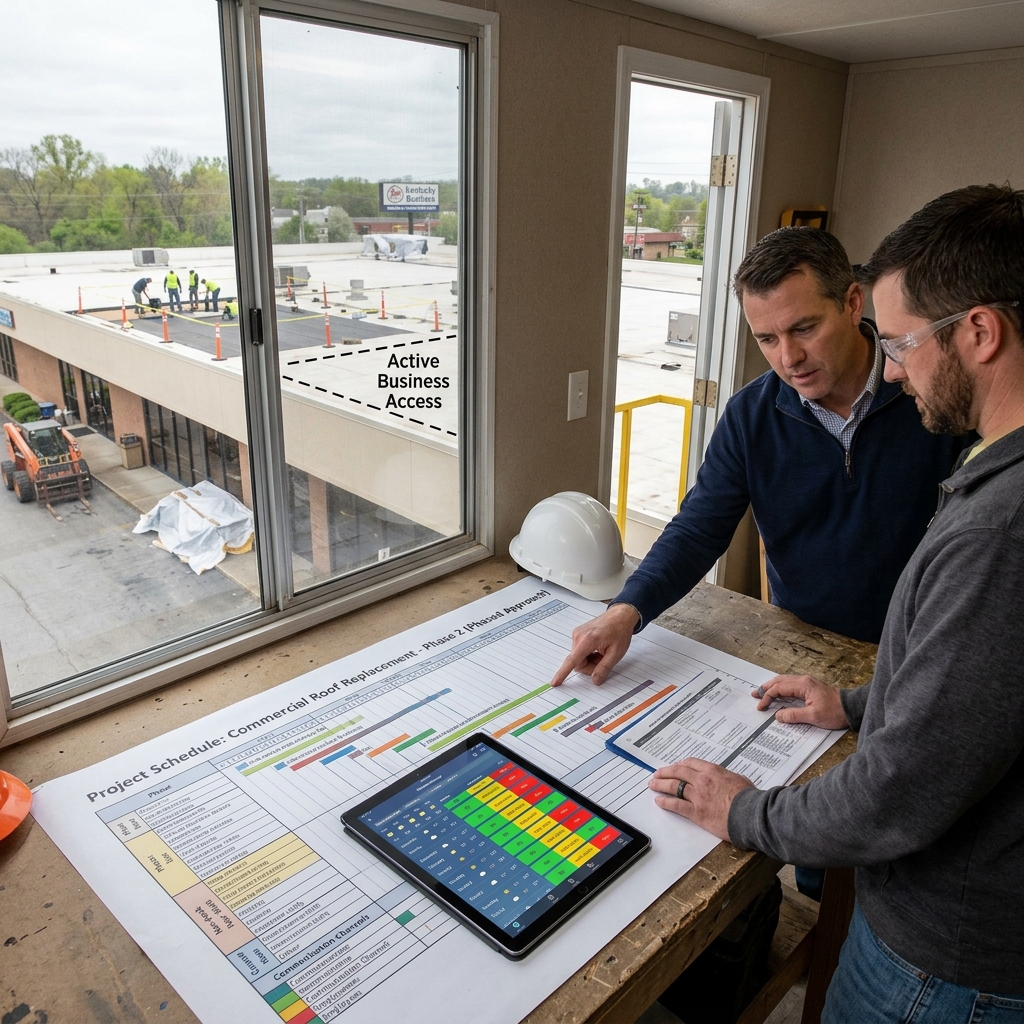
Smart scheduling builds in flexibility without guaranteeing excessive downtime. Here’s our approach:
Seasonal selection: We recommend scheduling roof work during Kentucky’s more stable weather windows. Spring (April-May) and early fall (September-October) offer the most reliable conditions. We avoid high-risk periods like summer thunderstorm season or winter snow/ice risks.
Weekly weather monitoring: As the project approaches, we monitor the 10-day forecast and adjust the schedule if significant rain is predicted. Rather than pushing forward through poor conditions, we shift work to available days.
Built-in buffer days: Our timeline includes 2-3 extra days factored in for legitimate weather delays. Your committed completion date accounts for realistic Kentucky conditions; we’re not promising an impossible schedule.
Flexible crew deployment: Some work can proceed in light rain (interior preparations, material staging). Other work requires dry conditions. Our crew knows how to maximize productivity while respecting material requirements.
This isn’t an excuse for delays. It’s realistic planning that respects both roofing best practices and your business needs. A project that completes on week 3 instead of week 2 due to two rain days is far better than a project that stretches to week 5 because we didn’t plan for weather realistically.
Strategy 5: Post-Project Inspection and Rapid Restoration
The project isn’t complete when the last shingle is installed. Rapid restoration and thorough inspection protect both your building and your operations.
Our post-project process includes:
- Magnetic debris sweeps: We thoroughly inspect the entire roof and surrounding areas for any stray fasteners, metal pieces, or debris that could damage equipment or create hazards.
- Ground-level inspections: We walk the perimeter, parking lot, and adjacent landscaping to ensure no material debris remains.
- Interior inspections: We check building interiors for dust, debris, or any damage that may have occurred during work.
- Drainage system flush: New roofing occasionally creates debris in gutters and downspouts. We clear these and ensure water flows properly.
- Documentation and warranty review: We provide detailed documentation of completed work, materials used, and your warranty coverage. This becomes your reference for future maintenance.
- Quick turnaround on final walkthrough: Rather than disappearing for weeks, we schedule your final walkthrough within 2-3 days of project completion, address any minor touch-ups immediately, and close out the project.
One often-overlooked detail: parking lot restoration. If our equipment or material staging damaged parking surfaces, we coordinate repairs quickly to restore that space to your team. It’s a small detail that signals whether a contractor respects your overall operations.
The goal of this phase is simple: clear visual evidence that the project is truly complete, your building is secured with a new roof, and your operations can fully resume without wondering about hidden debris or incomplete details.
How Jeff Home Improvements Minimizes Your Business Disruption
For nearly 40 years, we’ve partnered with Kentuckiana commercial property owners navigating roof replacement. What we’ve learned is that minimizing disruption isn’t accidental. It’s the result of intentional planning, experienced crews, and genuine commitment to understanding your business.
Here’s what sets our approach apart:
Our Owens Corning Platinum Preferred Contractor status means we’re held to rigorous standards for quality, safety, and customer communication. That’s not just certification language; it’s accountability.
Our commercial roofing experience isn’t limited to residential properties. We understand the unique requirements of office buildings, retail spaces, warehouses, and multi-unit commercial structures. We know that commercial operations can’t simply shut down; they need strategic project management.
We offer virtual consultations and instant estimates, which means your team doesn’t need to spend hours coordinating in-person meetings. We can review your building, discuss your specific concerns, and deliver a customized timeline proposal quickly.
Our team understands Kentuckiana’s climate and seasonal patterns. We’re not a national franchise applying generic timelines. We’ve replaced thousands of roofs in this region; we know Louisville summers, spring storms, and fall conditions intimately. Our scheduling reflects that local expertise.
We maintain detailed commercial roof maintenance plans that help extend your roof’s service life and catch minor issues before they become major repairs. This forward-looking approach reduces emergency disruptions down the road.
When we take on your commercial roof replacement, we’re not just replacing materials. We’re protecting your business continuity while we upgrade your building’s protection. Those two goals drive every decision we make.
Comparing Our Approach to Standard Roofing Contractors
Not all commercial roofing contractors operate with the same commitment to disruption minimization. Here’s how our approach differs:
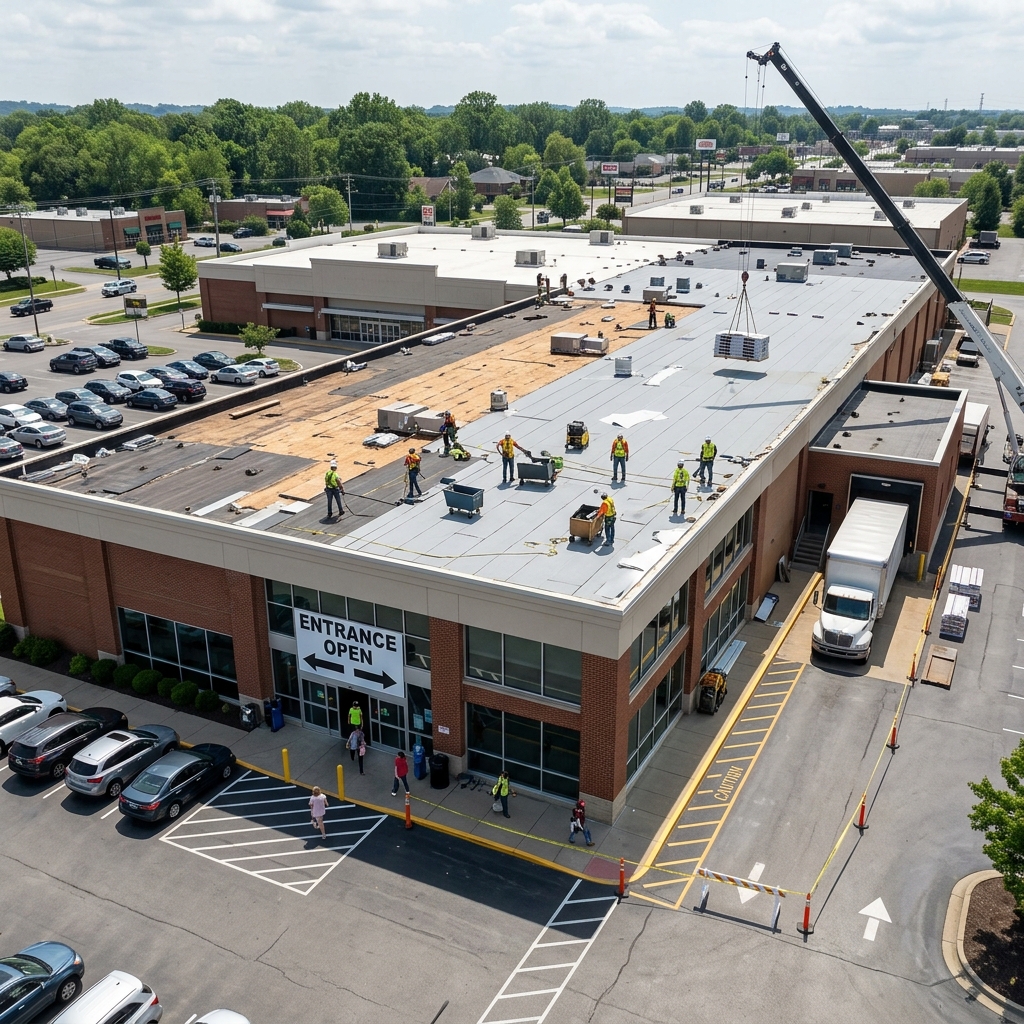
Standard contractors often operate on a fixed schedule regardless of your business rhythm. “We’ll be there weeks 3 and 4 of June” becomes their timeline, with little adjustment for your peak operations. You adapt to their schedule.
We customize the schedule to your operations. We ask questions about your business, peak times, seasonal fluctuations, and employee needs. Your operations shape our timeline, not the reverse.
Standard contractors may minimize communication until issues arise. You’re left wondering what’s happening, when disruption will peak, and whether unexpected problems are developing.
We maintain regular check-ins and proactive updates. You always know what’s happening, what to expect next, and how the project is tracking against the plan.
Standard contractors treat weather delays as an excuse for extended timelines. “The project will take however long it takes” becomes their answer, leaving you uncertain about your actual disruption window.
We build realistic timelines with weather buffers, so unexpected rain doesn’t cascade into weeks of additional disruption. We’ve planned for Kentucky conditions.
Standard contractors finish the job and move to the next project. You’re left managing any final details, debris, or questions.
We complete thorough post-project inspection, debris removal, and documentation, then schedule a final walkthrough to confirm you’re satisfied. The project truly ends when you confirm completion, not when our trucks leave.
Standard contractors may view commercial work as a job, plain and simple.
We view it as a partnership. Your business success matters to us because our reputation depends on completing projects that keep your operations running smoothly. That’s fundamentally different.
Why We’re Your Best Choice for Commercial Roof Replacement
Choosing a contractor for commercial roof replacement is choosing a partner who will directly impact your business operations during a significant project. That decision deserves careful thought.
We’re your best choice for several concrete reasons:
Proven track record in Kentuckiana: Nearly four decades of satisfied commercial clients in the Louisville area isn’t marketing language. It’s evidence that we consistently deliver on the promise of quality work with minimal disruption.
Owens Corning Platinum Preferred Contractor status: This certification means we meet rigorous standards for material quality, installation expertise, and customer communication. It’s third-party validation of our commitment to excellence.
Comprehensive service scope: Whether you need complete commercial roof replacements, storm damage repair, or exterior upgrades, we handle the full spectrum of your building’s exterior needs. That means one coordinated contractor rather than juggling multiple vendors.
Experience with disruption-sensitive projects: We’ve worked on active office buildings, operating retail locations, functioning warehouses, and multi-unit complexes where every day of downtime costs money. We understand the stakes.
Local expertise: We know Louisville’s climate, seasonal weather patterns, permitting processes, and building characteristics. We’re not applying a national playbook; we’re using regional expertise built over decades.
Transparent communication and realistic planning: We don’t promise impossible timelines or surprise you with unexpected costs. We communicate clearly about what to expect, how long it will take, and what your investment includes.
Dedicated project management: Your project isn’t one of dozens managed by a rotating roster of coordinators. You have a clear point of contact who understands your specific building, business needs, and timeline.
Rapid response and flexibility: If a weather event or unexpected structural issue emerges, we have the team capacity and expertise to respond quickly and adjust plans without derailing the entire project.
When you partner with us for your commercial roof replacement, you’re not just getting a new roof. You’re getting a contractor who prioritizes keeping your business running smoothly while we upgrade your building’s most critical protection system. That’s the difference between a contractor and a true partner.
Ready to discuss your commercial roofing project? We offer free virtual consultations and instant estimates. Contact us through our website or call today to talk through how we can minimize disruption while delivering the quality roof your building needs.
Contact us today for a free in home, no obligation quote on your roof




 INDIANA
 KENTUCKY