
Why Energy Efficiency Matters for Your Roof Investment
Your roof represents one of the largest investments you’ll make in your Kentucky home or commercial property. Unlike many upgrades that wear out or fall out of style, a quality roof protects your building for 20 to 50 years while directly impacting your heating and cooling costs every single month.
An energy-efficient roof doesn’t just sit above your head looking weatherproof. It actively works to manage the heat that radiates into your attic space and back out through the roof. During Kentucky’s hot, humid summers, your air conditioning system works overtime if your roof absorbs and traps solar heat. During winter, poor roof insulation and ventilation can cause heat loss that forces your furnace to run harder. Both scenarios drain your wallet.
The real value of an energy-efficient roofing material becomes clear when you add up those monthly savings over decades. Many homeowners focus only on the upfront cost of roof replacement. They choose the cheapest option without realizing they’re locking in higher energy bills for the next 25 years. That’s the trap we help our customers avoid.
Energy efficiency also ties directly to comfort. Properties with high-performing roofs maintain more consistent indoor temperatures, reduce drafty spots, and lower the strain on HVAC equipment. Your systems last longer, and you experience fewer unexpected breakdowns.
Action Item: Before choosing roofing materials, identify your current energy costs. Pull your utility bills for the last 12 months and calculate your average monthly heating and cooling expense. This baseline helps you measure savings later.
How Roof Performance Impacts Your Monthly Energy Costs
Your roof’s performance is measured by its ability to reflect solar radiation, allow proper ventilation, and work with your insulation system. These three factors work together to determine how much conditioning energy you’ll spend annually.
Solar heat absorption happens primarily on the roof surface. A standard dark-colored asphalt shingle can reach temperatures of 140 to 180 degrees Fahrenheit on a sunny Kentucky summer day. That extreme heat radiates downward into your attic, warming the air below the roof deck. Your air conditioner must then cool not only the living spaces but also counteract that radiant heat loss from above. Over a summer season, this translates to weeks of extra runtime.
Ventilation is equally critical. Even with good insulation, a poorly ventilated attic traps hot air that has nowhere to escape. Proper soffit and ridge ventilation allows convective cooling in the attic space itself, reducing the temperature difference between your roof deck and the air inside your home. Without adequate ventilation, even reflective materials lose much of their benefit.
Insulation quality in your attic also matters. A roof doesn’t insulate on its own; the insulation sits in your attic below. However, if your roof allows moisture accumulation or thermal bridging due to poor installation, the insulation’s effectiveness drops significantly. This is why installation quality directly impacts energy performance.
Real numbers: A typical 2,000-square-foot home in the Kentuckiana area spends 40 to 60 percent of its annual energy budget on heating and cooling. If an energy-efficient roof reduces that load by 15 to 25 percent through lower heat gain in summer and reduced convective loss in winter, you’re looking at annual savings of $400 to $1,200 depending on your utility rates and current roof age.
Action Item: Have a qualified contractor perform a basic energy audit of your attic space. They’ll assess ventilation, insulation depth, and any thermal issues. This costs little but identifies where your biggest energy losses actually occur.
Owens Corning Platinum Roofing: Our Recommended Solution
We are proud to be an Owens Corning Platinum Preferred Contractor, and we recommend their premium roofing products for Kentucky properties specifically because they solve the energy efficiency problem better than standard alternatives.
Owens Corning Platinum shingles feature a proprietary reflective granule technology that dramatically reduces solar heat absorption compared to standard asphalt shingles. The granules are engineered to stay cooler longer and reflect more of the sun’s infrared energy away from your roof deck. This cooling effect is measured using a solar reflectance value, and Owens Corning’s premium line consistently outperforms competitors in independent testing.
Beyond reflectivity, Owens Corning products integrate better with proper installation practices we follow at Jeff Home Improvements. Their shingles are designed to work seamlessly with modern ventilation systems and underlayment technology. The company also provides extended warranties on both materials and wind resistance, giving you protection that matches the premium investment.
What sets Owens Corning apart for Kentucky specifically is their attention to humidity and moisture management. Our region experiences high humidity levels, especially during spring and fall. Owens Corning’s formulations are engineered to resist moisture-related degradation that can otherwise shorten roof life and reduce insulation effectiveness.
Owens Corning Platinum products come in multiple color options that still deliver high reflectance without requiring you to choose white or light gray exclusively. You get aesthetic flexibility without sacrificing energy performance, which matters if you’re concerned about curb appeal or matching your home’s existing architecture.
Action Item: Request samples of Owens Corning Platinum shingles in your preferred colors. See them in real daylight on your home’s orientation. The reflectance benefit is real, but you should feel confident about the appearance as well.
Cool Roof Technology and Reflectivity Benefits
Cool roof technology is built on a simple but powerful principle: reflective surfaces bounce solar radiation away from your building rather than absorbing it as heat. This isn’t new technology, but the engineering behind modern cool roofing materials has advanced significantly.
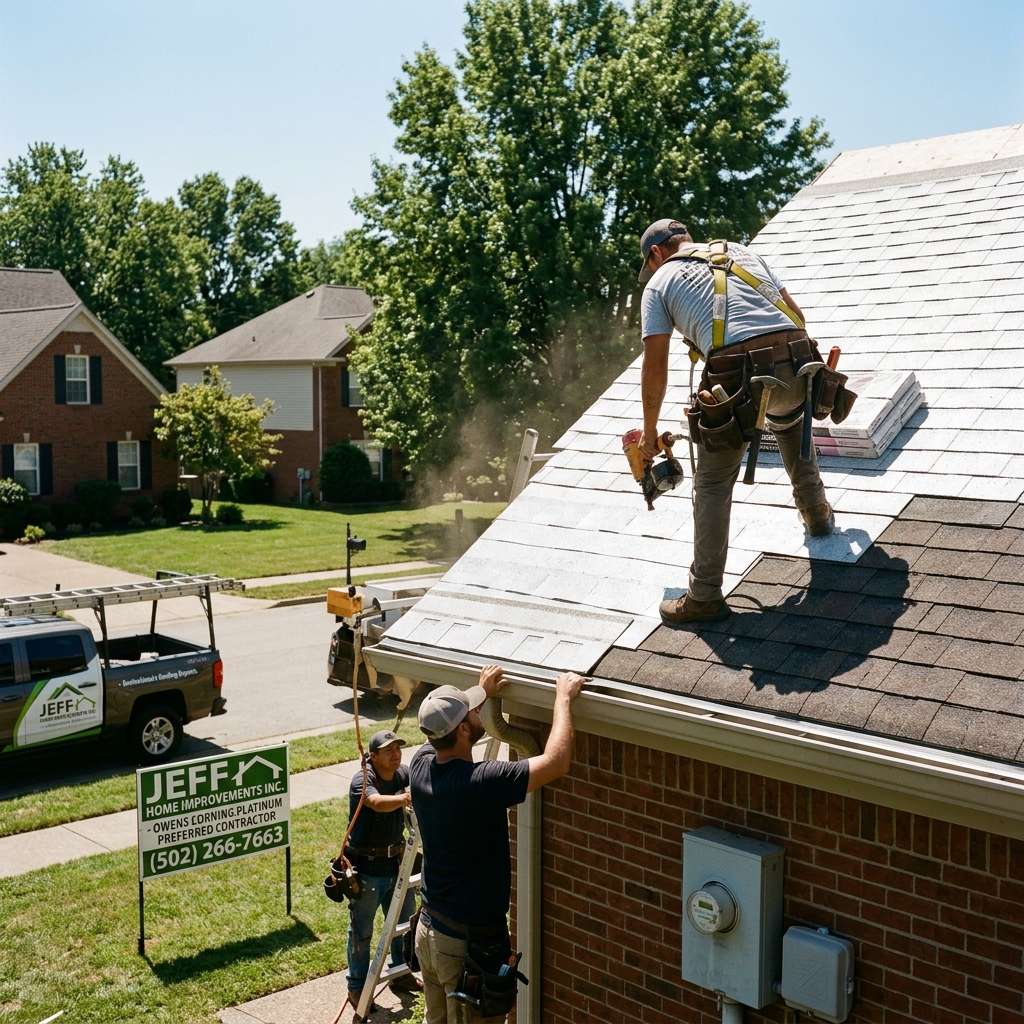
Solar reflectance is measured on a scale from 0 to 1, where 1 represents perfect reflection. Standard dark asphalt shingles typically measure 0.05 to 0.15 in reflectance, meaning they absorb 85 to 95 percent of the sun’s energy. Owens Corning Platinum shingles achieve reflectance values of 0.60 to 0.75, reflecting 60 to 75 percent of solar radiation. That four-fold to five-fold improvement directly translates to lower attic temperatures and reduced cooling demand.
The reflectance benefit extends throughout your building envelope. When your attic stays cooler, the temperature gradient pushing heat into your living spaces decreases. Your air conditioning system doesn’t have to work as hard to maintain setpoint temperatures. In testing by the Cool Roof Coalition and independent research labs, cool roofs consistently reduce roof surface temperatures by 30 to 50 degrees Fahrenheit on sunny days.
Some property owners worry that cool roofs look washed out or cheap. Modern cool roofing materials use advanced granule technology to deliver reflectance while maintaining rich colors and traditional aesthetics. You’re not choosing between energy savings and curb appeal anymore.
Thermal emittance, the second component of cool roof performance, measures how efficiently a material releases absorbed heat. High-quality roofing materials release that heat quickly rather than storing it. This matters during late afternoon and evening hours when your roof is still warm but the outdoor air is cooling down. Good thermal emittance allows your roof to shed its accumulated heat quickly.
Action Item: Compare the solar reflectance ratings of any roofing products you’re considering. Request this specification from manufacturers or your contractor. The difference between 0.3 and 0.65 reflectance directly impacts your annual energy costs.
Long-Term Savings and Return on Investment Analysis
Energy-efficient roofing pays for itself through monthly utility savings, but the timeline depends on your current roof condition, local energy rates, and the specific materials you choose.
For a typical 2,000-square-foot Kentucky home, upgrading from an aging, poorly-insulated dark roof to an energy-efficient system with proper ventilation and modern materials can generate $500 to $1,500 in annual energy savings. Owens Corning Platinum shingles cost approximately $1.50 to $2.00 per square foot installed, which puts a complete roof replacement in the $12,000 to $20,000 range for residential properties depending on complexity.
Using conservative estimates, a $16,000 roof investment delivering $800 annual energy savings achieves payback in 20 years. However, most Kentucky homeowners remain in their homes or maintain the same commercial properties for far longer than the payback period. If you keep your property for 30 to 40 years, you’re looking at $24,000 to $32,000 in cumulative energy savings from that single upgrade.
The ROI calculation improves when you factor in non-energy benefits. A new roof extends your home’s marketable lifespan by 25 to 30 years. If you eventually sell, newer roofing systems command higher property values, often recouping 50 to 80 percent of the roof replacement cost in resale value. A home inspector or appraiser will note your recent, high-quality roof as a major positive selling point.
Storm damage also affects ROI. Energy-efficient roofing materials from premium manufacturers like Owens Corning are engineered to withstand Kentucky’s severe weather better than standard options. This reduces the probability of costly storm repairs or premature replacement. Over the roof’s lifespan, you’re not just saving on monthly energy but also avoiding one or two emergency repairs that would cost thousands.
Consider too the comfort factor. Monthly energy savings aren’t purely financial; they represent months and years of more consistent indoor temperatures and fewer drafty spots. This quality-of-life improvement has real value even if it doesn’t appear in a spreadsheet calculation.
Action Item: Use the simple payback formula: Total Roof Cost divided by Annual Energy Savings equals Payback Period in Years. Calculate your specific payback using your home’s square footage, local energy rates, and current roof condition.
Storm Damage Protection and Energy Efficiency Combined
Kentucky experiences significant storm activity, including high winds, hail, and heavy rain. An energy-efficient roof that can’t withstand severe weather becomes a bad investment quickly. Fortunately, premium materials and professional installation address both concerns simultaneously.
Owens Corning Platinum shingles are engineered with strong asphalt matrices and adherent granule coatings that resist impact from hail. Their products carry impact resistance ratings that perform well in independent testing. Wind resistance extends to extreme conditions; properly installed Owens Corning shingles meet or exceed ASTM standards for wind uplift forces that far exceed typical Kentucky wind speeds.
Our installation practices reinforce this storm protection. We use proper nailing sequences, quality underlayment, and ventilation systems that work together to create a complete weather barrier. A roof installed improperly by a less experienced contractor may have beautiful appearance but fail during the first major storm. We invest in our crews’ training specifically because installation quality is where energy efficiency and storm protection intersect.
If storm damage does occur, an energy-efficient roof system protects your home’s interior and insulation from water penetration and moisture damage. Water intrusion degrades insulation performance and can lead to mold growth, structural damage, and long-term efficiency loss. Premium roofing systems with proper underlayment and ventilation prevent these cascading problems.
Additionally, homeowners and commercial property managers in Kentucky often benefit from insurance coverage for roof replacement following hail or wind damage. An energy-efficient upgrade path means when you file a claim, the replacement material is more efficient than what it replaces, providing a silver lining to storm damage.
Action Item: Review your homeowner’s or commercial property insurance policy. Understand your coverage limits for roof damage and any deductibles. Ask your insurance agent whether certain roofing materials qualify for discounts based on their storm resistance.
Installation Quality and Energy Performance Guarantees
Material quality matters, but installation quality determines whether you actually achieve the energy savings that products promise. This is where we differentiate ourselves.
As an Owens Corning Platinum Preferred Contractor, we’ve completed extensive training on proper installation techniques that preserve the energy performance characteristics of their premium products. Incorrect nailing patterns, inadequate ventilation setup, or poor underlayment installation can reduce energy efficiency by 30 to 50 percent even with the best materials.
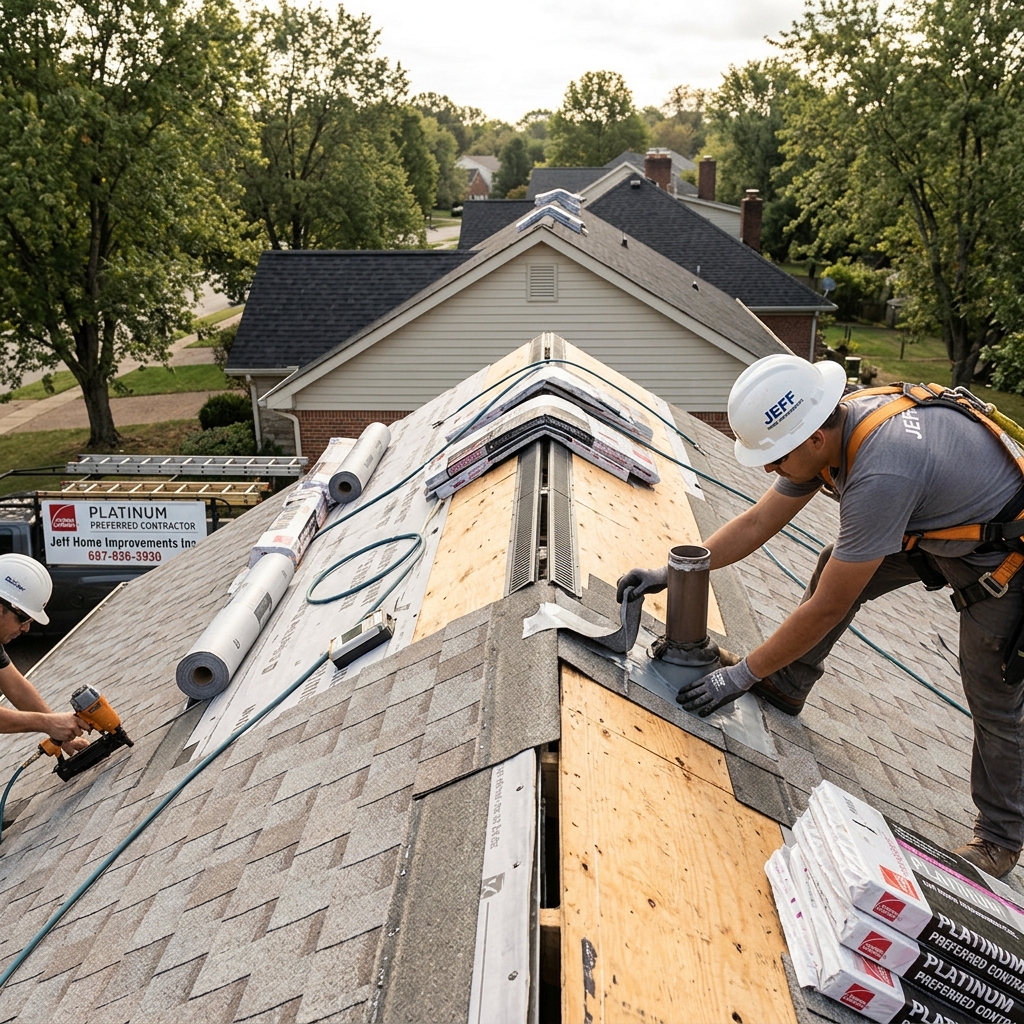
Our crews understand the relationship between roof deck ventilation, attic ventilation, insulation R-value, and overall system performance. We don’t just install shingles; we engineer your entire roof system. This includes proper soffit ventilation intake, ridge ventilation exhaust, ventilation baffles in insulated attics, and ice and water shield placement that balances protection with breathability.
We offer performance guarantees that standard contractors don’t. On Owens Corning Platinum installations, we back our workmanship for 10 years and provide complete transparency on what that coverage includes. We also document our installation process with photos and detailed notes, giving you proof that your roof was installed to specification.
Warranties from product manufacturers typically cover material defects for 25 to 50 years depending on the product line. Our workmanship warranty covers improper installation during our crew’s work. Together, these warranties mean you’re protected against both material failure and installation error. If energy performance degrades because of something we did wrong during installation, we stand behind the work.
Action Item: Request a copy of any performance guarantees or workmanship warranties in writing before signing any contract. Understand exactly what’s covered, for how long, and what actions on your part might void coverage.
Comparing Premium vs. Standard Roofing Options
The roofing market offers options at multiple price points. Understanding what you’re trading off helps clarify the ROI question.
Standard asphalt shingles from commodity manufacturers typically cost $0.70 to $1.00 per square foot installed. They carry 15 to 20-year warranties on materials and provide adequate weather protection for most conditions. However, their solar reflectance values typically fall between 0.05 and 0.20, meaning they absorb 80 to 95 percent of solar radiation. This limits your energy savings to perhaps 5 to 10 percent annually compared to an extremely old, weathered roof.
Mid-grade architectural shingles cost $1.00 to $1.50 per square foot and offer better aesthetics and slightly improved durability. Some include basic reflective properties that achieve 0.25 to 0.40 solar reflectance. These provide moderate energy benefits, roughly 10 to 15 percent annual savings, and are suitable for homeowners seeking a balance between cost and performance.
Premium products like Owens Corning Platinum cost $1.50 to $2.00 per square foot but deliver solar reflectance ratings of 0.60 to 0.75 and comprehensive warranties. These generate 15 to 25 percent annual energy savings and superior storm protection.
Higher-end specialty materials like standing seam metal roofing or premium tile can exceed $3.00 per square foot and offer extreme durability and reflectance. These work well for certain architectural styles or extreme climate zones but may be overkill for typical residential applications in our region.
The financial comparison is straightforward: Standard materials cost $14,000 less but generate $200 to $400 less in annual energy savings, extending payback by 35 to 70 years. Mid-grade materials split the difference, offering reasonable savings at moderate cost. Premium materials deliver optimal energy performance and justify the upfront investment through long-term savings and property value impact.
For most Kentucky property owners, we recommend premium Owens Corning Platinum products because they represent the best balance of performance, durability, aesthetics, and ROI within the market.
Action Item: Request quotes for at least three material tiers from your contractor. Compare the total installed cost and estimate the annual energy savings for each option. Calculate payback period to see the financial difference clearly.
How to Calculate Your Specific Energy Savings
Generic figures about energy savings don’t tell you what you’ll actually save. Your specific savings depend on multiple property-specific factors.
Start by gathering your current utility bills for 12 months. Calculate your average monthly electric bill (cooling season) and heating bill (winter months). Separate these if possible, since roof improvements affect cooling much more dramatically than heating.
Next, estimate your roof’s current solar reflectance. If it’s dark asphalt showing age and weathering, assume reflectance of 0.10. If it’s relatively new mid-grade material, assume 0.30. If it’s light-colored material in good condition, assume 0.50. The new Owens Corning Platinum system will achieve 0.68 reflectance.
Use this simplified formula: Estimated Annual Cooling Savings = (Current Monthly AC Cost) x (12) x (0.20). This assumes a 20 percent reduction in cooling load from upgrading to high-reflectance roofing. For heating, assume 5 to 10 percent savings since roof improvements help but insulation and air sealing matter more for winter performance.
As a real example: If your current annual AC costs are $1,200 and heating costs are $1,600, estimated annual savings would be $240 from cooling plus $80 to $160 from heating, totaling $320 to $400 annually.
This simplified approach underestimates savings because it doesn’t account for peak demand reduction, time-of-use rate benefits, or improved system efficiency. For more precise calculations, we offer virtual energy assessments that analyze your specific property, climate data, and usage patterns.
More sophisticated energy modeling software can provide estimates accurate to within 10 to 15 percent. This modeling costs $200 to $500 but delivers actionable numbers for major financial decisions. For commercial properties or large residential investments, this professional analysis often justifies its cost.
Action Item: Perform the basic savings calculation above using your actual utility bills. Then contact us for a free virtual consultation to refine these estimates based on your property’s specific characteristics.
Combining Roofing Upgrades with Siding and Ventilation
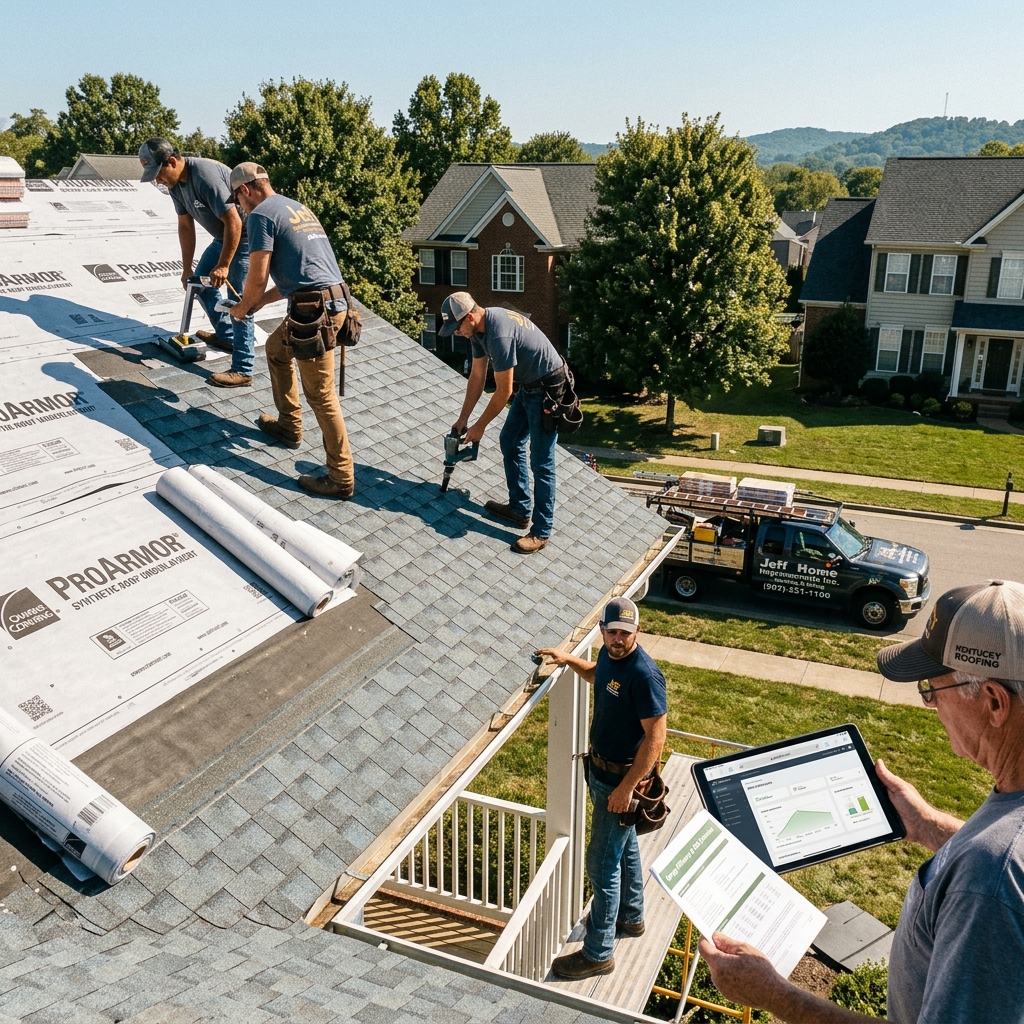
Your roof performs best as part of a coordinated home envelope strategy. Siding condition, ventilation adequacy, and insulation all interact with roofing performance to determine overall energy efficiency.
Poor siding allows air infiltration around windows and doors, undermining your roof’s heat management benefits. If cool outdoor air leaks out in summer or warm indoor air leaks out in winter, your HVAC system cancels out the roof’s energy benefits. Vinyl siding installation or replacement addresses this by creating a tighter thermal envelope while complementing your new roof’s appearance.
Attic ventilation is equally critical. A new high-reflectance roof works best with modern soffit-to-ridge ventilation that handles 1 square foot of ventilation opening per 150 square feet of attic area. Many older Kentucky homes have inadequate ventilation or blocked soffit openings. Addressing this during roof replacement captures the full energy benefit potential.
Insulation depth matters too, though it’s separate from roofing. If your attic has minimal insulation, even the best roof won’t deliver optimal energy savings. Coordinating insulation upgrades with roof replacement is cost-efficient since your attic is already open for roof work.
We handle roofing, siding, and ventilation as part of our service offerings. This allows us to design comprehensive exterior upgrades that work as a system rather than isolated improvements. A homeowner who upgrades only the roof but ignores poor siding and ventilation captures perhaps 60 to 70 percent of potential energy savings. A coordinated exterior improvement approach captures 85 to 95 percent.
Action Item: Walk your property’s exterior and note problem areas. Look for: dark or discolored siding (air leakage or moisture issues), blocked soffit vents, gaps around windows, and visible attic moisture staining if you can access the attic safely. These observations inform a comprehensive upgrade plan.
Our Financing Options for Qualified Homeowners
The upfront cost of premium roofing and coordinated exterior work can feel daunting. We offer several financing options to make these energy-saving upgrades accessible.
Most homeowners qualify for standard home improvement financing through our preferred lenders. These typically offer fixed rates between 5 and 8 percent with terms ranging from 5 to 20 years. Monthly payments fit within many budgets, and the monthly energy savings offset a meaningful portion of the financing cost.
Energy-efficient home improvements also qualify for federal and state tax incentives in many cases. The federal Residential Energy Efficient Property Credit provides up to $3,200 in credits for qualified energy-saving upgrades including roofing. Kentucky offers additional incentives for certain improvements. These credits reduce your tax liability dollar-for-dollar in the year the work is completed.
Property-Assessed Clean Energy (PACE) financing is available in some Kentucky jurisdictions. This attaches financing to the property rather than the homeowner personally, offering longer terms and potentially better rates. The repayment is attached to property tax bills.
For commercial properties, Energy Service Agreement (ESA) financing allows the energy savings themselves to fund the upgrade cost. You pay for the improvement over time using the money you save on utilities, often resulting in neutral or positive cash flow from year one.
We can guide you through available options and help you understand which financing approach makes sense for your situation. Our team has experience working with all major lending programs and can often pre-qualify you before you commit to a project.
Action Item: Gather recent utility bills and tax return information, then call for a financing consultation. We’ll identify which programs you likely qualify for and provide specific monthly payment estimates for your project.
Get Your Free Energy Efficiency Assessment Today
The best way to understand your specific energy-saving potential is to have a professional assess your property. We offer free virtual consultations and instant estimates that account for your home’s unique characteristics.
Our assessment process evaluates your current roof condition, existing insulation, ventilation adequacy, siding integrity, and usage patterns. We analyze your utility bills and discuss your comfort concerns. This information guides personalized recommendations rather than generic product suggestions.
The virtual consultation means you get expert evaluation without scheduling a crew visit or taking time away from work. You’ll receive a detailed report outlining: current energy inefficiencies, estimated savings from various upgrade options, specific material recommendations, financing estimates, and project timelines.
We’re confident in the value we deliver because we’ve served the Kentuckiana area since 1989, completing thousands of roofing and exterior projects. Our track record as an Owens Corning Platinum Preferred Contractor reflects our commitment to quality and energy performance.
Energy-efficient roofing isn’t a luxury upgrade; it’s a practical investment that saves money, improves comfort, and increases property value. The sooner you address an aging or inefficient roof, the sooner those monthly energy savings begin accumulating.
Starting is simple. Visit our website or call to schedule your free assessment. We’ll analyze your property, answer your questions, and provide a clear financial picture of your energy-saving potential. No obligation, no pressure, just expert guidance on one of the most important investments you’ll make in your Kentucky home or business.
For further reading: Louisville roofing contractor.
Contact us today for a free in home, no obligation quote on your roof




 INDIANA
 KENTUCKY