
Why Getting Multiple Roof Replacement Bids Matters for Your Budget
Roof replacement is one of the largest home improvement investments a Louisville homeowner will make. Prices typically range from $8,000 to $25,000 or more depending on square footage, materials, and complexity. Getting just one bid leaves you blind to market rates and vulnerable to either overpaying or, worse, choosing a contractor who cuts corners to hit a low price.
When you request bids from multiple contractors, you establish a baseline understanding of what the work should cost in the Kentuckiana market. This comparison reveals patterns. You’ll notice which contractors are premium-priced because of superior materials and warranty terms, which ones fall in the middle, and which ones may be suspiciously cheap.
We recommend collecting at least three detailed bids before making a decision. This doesn’t mean picking the lowest number. Instead, it gives you the information needed to spot value, identify red flags, and understand what separates a budget contractor from one that delivers long-term protection for your home.
Action to take: Contact three to four roofing contractors this week and request in-person inspections with detailed written estimates.
Key Criteria We Use When Evaluating Roofing Quotes
When we review a roofing project from initial inspection through final estimate, we evaluate several core elements. Understanding these helps you read any bid like an expert.
Square footage and roof pitch form the foundation. A contractor should climb your roof, measure the actual area, and note the pitch (angle). Estimates based on photos or rough approximations lack the precision needed for an accurate quote.
Material specifications matter enormously. A bid should specify the shingle type (architectural, designer, premium), color, and manufacturer. Two bids quoting “asphalt shingles” at different prices might be comparing 20-year shingles to 30-year shingles. The difference is real value, not just cost.
Scope of work clarifies what’s included. Does the bid include tear-off of existing roofing, or is that extra? What about replacing damaged wood, new flashing, venting upgrades, or debris removal? A thorough bid breaks these out separately so you understand exactly what you’re paying for.
Worksite conditions affect labor. If your home sits on a steep pitch, has multiple levels, or has limited roof access, installation takes longer. Good contractors factor this into labor estimates.
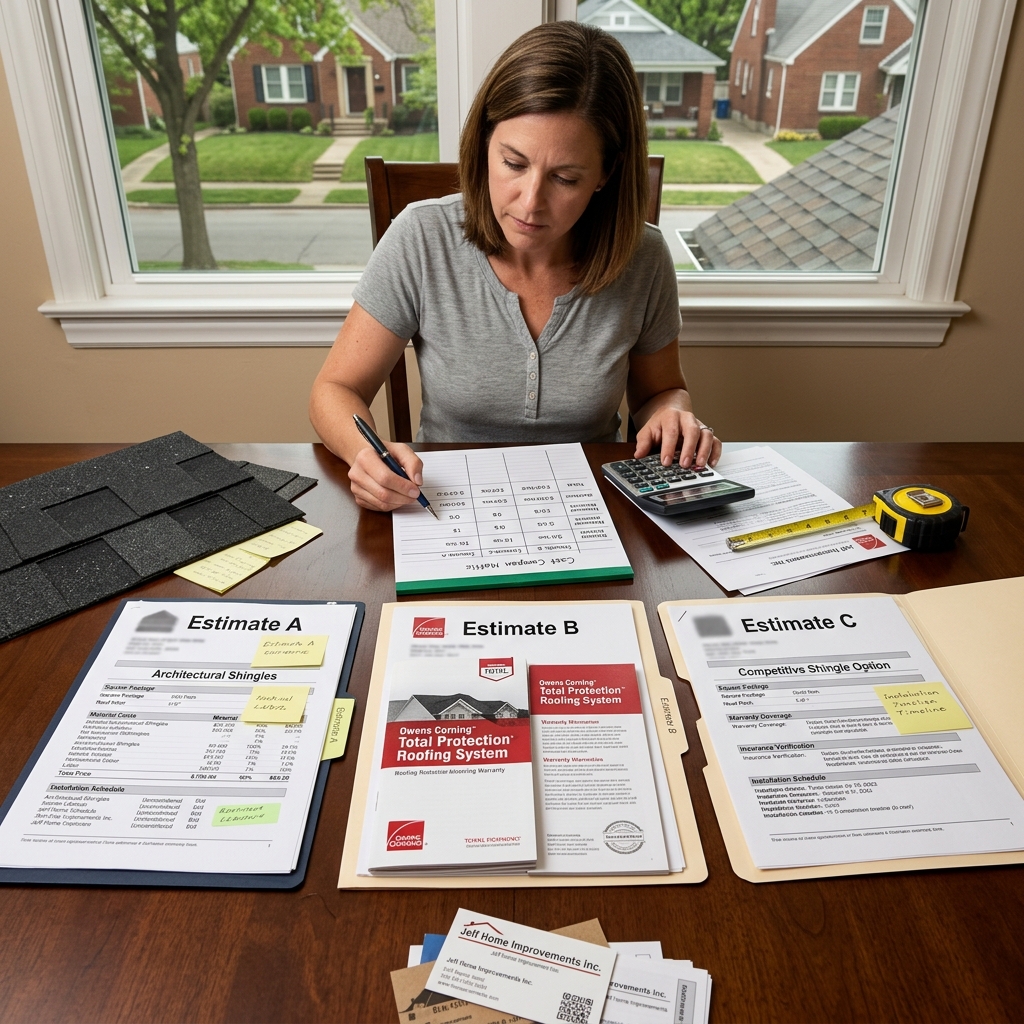
Take time to line up your three bids with these criteria in mind. When comparing, use a simple spreadsheet listing the same line items across each quote. This makes differences visible at a glance.
Action to take: Create a spreadsheet with columns for square footage, material grade, tear-off cost, labor, flashing, and cleanup. Fill it in from each bid so you see what varies.
Understanding Material Quality and Warranty Coverage in Bids
The quality of roofing materials creates the biggest gap between budget options and premium choices. Many homeowners focus only on price and miss how warranty coverage differs dramatically.
Standard architectural shingles carry manufacturer warranties of 20 to 25 years. Designer or impact-resistant shingles jump to 30 years or longer. Premium shingles from top manufacturers like Owens Corning offer superior wind resistance, fire ratings, and color retention. A 30-year shingle isn’t twice the cost of a 20-year shingle, but it delivers significantly longer life and better performance.
Here’s what matters: The warranty is only valid if installed by a certified contractor. A cheap installation voids the warranty, even if you bought premium materials. This is why contractor certification matters as much as material choice.
Workmanship warranties vary too. Some contractors offer one-year workmanship guarantees. Better ones extend to five years or more. We stand behind our installations with comprehensive coverage because we’re confident in our work and our team’s training.
Look at what’s covered. Does the warranty protect against wind damage, hail, weather, or just manufacturer defects? A warranty that doesn’t cover weather-related claims is less valuable in Kentucky, where spring storms are routine.
Our roof replacement warranties page details what homeowners should expect. When comparing bids, ask each contractor for their warranty documentation in writing before you sign anything.
Action to take: Request warranty details in writing from each contractor and compare coverage side by side, not just the warranty length.
Labor Costs and Installation Timeline Comparison
Labor typically accounts for 40 to 60 percent of a roof replacement cost. Understanding how contractors price labor reveals a lot about their operation.
Professional roofing crews work faster than inexperienced teams, but speed matters less than skill. A crew that rushes through flashing installation or nail placement creates leaks years later. You want a contractor who prioritizes correctness over speed.
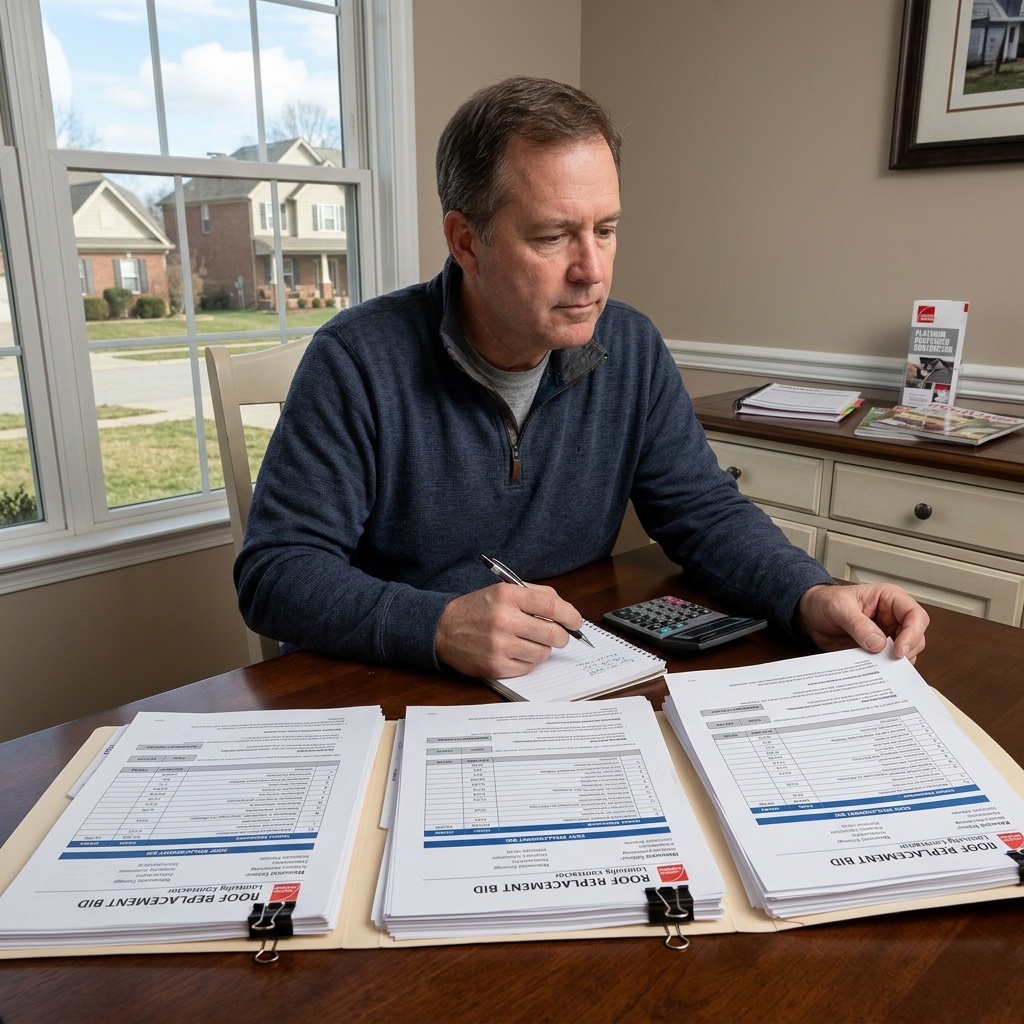
Timeline expectations should be realistic. A standard 2,500-square-foot residential roof takes three to five days with a full crew, depending on weather and complexity. If a bid promises completion in one day, something’s wrong. If another quotes three weeks, they may be scheduling multiple projects simultaneously or understaffed.
Weather impacts scheduling too. A contractor should state the timeline as “weather permitting” and explain how rain delays are handled. Our crews work efficiently while maintaining the care required for long-term durability.
Labor costs in Louisville vary based on contractor experience, crew size, and overhead. A smaller operation might quote lower labor rates but take longer. A larger, better-equipped contractor may charge more per hour but finish faster, which matters if you need protection from an upcoming storm.
Action to take: Ask each contractor how many crew members will be assigned, their experience level, and how long they typically require for a roof similar to yours.
Insurance and Bonding Requirements You Should Verify
This is non-negotiable: Your contractor must carry workers’ compensation insurance and liability coverage. If a crew member is injured on your property and the contractor isn’t insured, you could be liable.
Ask for proof of insurance before work begins. Request a Certificate of Insurance naming your address as additionally insured. Legitimate contractors provide this immediately. If a contractor hesitates, walks away.
Bonding is equally important. A performance bond guarantees the job is completed as specified. If the contractor abandons the job or fails to meet terms, the bond protects you. A payment bond ensures subcontractors and suppliers are paid, preventing mechanic’s liens against your home.
We maintain full workers’ compensation, liability, and surety bonding. It’s a cost we bear because it protects our customers and reflects our commitment to legitimate, professional work.
When comparing bids, don’t assume all contractors are equally insured. Call their insurance agent to verify coverage is active. Check the Kentucky Secretary of State database to confirm they’re licensed. These checks take 15 minutes and protect you from thousands in potential liability.
Action to take: Call the insurance company listed on each bid and verify coverage limits and active status. Also check Kentucky licensing records online.
Red Flags to Spot in Suspicious or Underpriced Bids
Some bids are legitimately cheaper because the contractor operates efficiently, has lower overhead, or is building relationships in a new market. Other low bids reflect cutting corners, inexperience, or financial instability.
Extremely low pricing relative to other bids (20 percent or more below average) warrants skepticism. If you get three bids at $15,000, $15,500, and $10,000, the low bid needs explanation. Ask directly why it’s lower. If the answer is vague or focused only on “we work faster,” that’s concerning.
Verbal estimates without detailed documentation are risky. A legitimate bid comes in writing, specifying materials, labor breakdown, timeline, and warranty. If someone quotes over the phone or via email without an in-person inspection, the bid isn’t reliable.
No insurance documentation is a major red flag. Established contractors provide proof immediately. Resistance or delay suggests they’re either uninsured or hiding something.
Pressure to pay upfront before work starts raises concerns. Standard practice is a deposit (typically 25 to 50 percent) upon signing, with final payment after completion and inspection. Requests for 100 percent payment upfront invite fraud.
Unlicensed or unregistered business is illegal in Kentucky. Any contractor unwilling to provide their license number is breaking the law. Verify it with the state before engaging.
Action to take: Research each contractor’s background online, check reviews on Google and BBB, and confirm they have an established local presence with years of history.
How We Structure Transparent Pricing and Detailed Estimates
Our approach to bidding reflects our commitment to honesty and clarity. Every estimate we provide includes the same level of detail, whether a roof costs $10,000 or $30,000.
We begin with a thorough roof inspection. Our crew photographs conditions, measures square footage, notes pitch and complexity, and identifies any underlying damage. This inspection takes time but ensures accuracy.
The written estimate then lists every cost separately: tear-off labor, disposal fees, new decking if needed, flashing replacement, shingle material and installation, gutters or guards if included, cleanup, and permits. We note the shingle grade, manufacturer, color, and warranty. We specify the timeline and weather contingencies.
Our estimates include options. For example, a customer might see the cost for a standard architectural shingle versus a premium grade from Owens Corning. Both are listed with their respective warranties so the choice is informed, not a sales pitch.
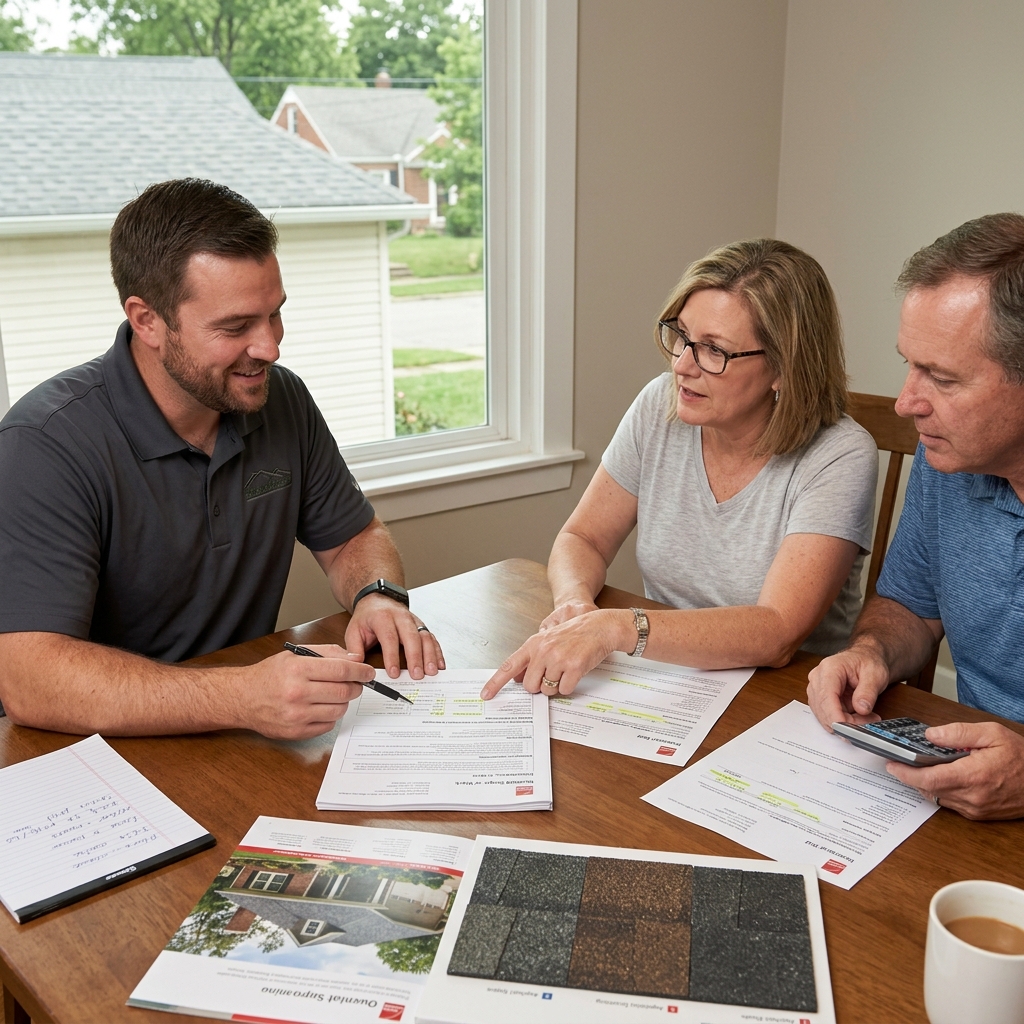
We also explain what’s not included. If fascia repair or soffit work isn’t part of the roofing scope, we note that but can provide a separate estimate if you ask.
Finally, we stand behind the estimate. Price holds for a specified period (usually 30 days), so you’re not surprised by changes if you need time to decide or arrange financing.
This transparency builds trust. Customers often comment that our detailed estimates take longer to review, but they appreciate understanding exactly what they’re paying for and why.
Action to take: When you receive bids, compare the level of detail. The most detailed estimate usually reflects the most professional operation.
The Advantage of Our Owens Corning Platinum Certification
Owens Corning Platinum Preferred Contractor status isn’t a marketing badge we picked up lightly. It reflects years of meeting strict standards for installation quality, customer service, and warranty support.
To achieve and maintain Platinum status, contractors must:
- Meet annual installation requirements (demonstrating consistent volume and experience)
- Maintain a high customer satisfaction rating
- Pass Owens Corning inspection audits
- Document proper training and certification for all crews
- Comply with rigorous warranty and claims processes
Not all roofing contractors carry this certification. Some install Owens Corning materials but lack the designation because they haven’t met the threshold or applied for it. That’s fine, but it means Owens Corning hasn’t verified their work quality to the same degree.
For you, Platinum certification means when something goes wrong with your roof, Owens Corning stands behind it faster. Warranty claims are processed more smoothly. If a dispute arises about workmanship, Platinum contractors have stronger leverage with the manufacturer to resolve it in your favor.
Our Owens Corning Platinum Contractor status comes from consistency. We’ve been installing quality roofs in Kentuckiana since 1989. Owens Corning materials are our primary choice because their products align with our commitment to durability and performance.
When you compare bids, ask if each contractor is Platinum certified. If not, ask why and whether they’ve applied. Some excellent contractors aren’t Platinum, but it’s worth understanding the difference.
Action to take: Ask each contractor about Owens Corning certification and request their Platinum status documentation if they claim it.
Virtual Consultations: Getting Accurate Bids Without the Guesswork
In 2026, you don’t have to wait around for an in-person appointment to get a quality estimate. We offer virtual consultations that deliver surprisingly accurate bids without requiring you to clear a day from your schedule.
Here’s how it works: You provide photos and videos of your roof (using your phone’s camera). You answer a few questions about age, previous repairs, and current issues. We use that information to assess the work required, then provide an instant or next-day estimate.
Virtual estimates work best for straightforward replacements on standard-pitch roofs. For complex jobs, steep pitches, multiple levels, or significant structural concerns, an in-person inspection is more reliable. We’re honest about this limitation and recommend an on-site visit when accuracy demands it.
The advantage of virtual estimates is speed and flexibility. You get a ballpark figure without obligation, which helps you plan a budget and narrow your contractor search before committing time to multiple in-person visits. If you like the estimate and want more detail, we then schedule a full inspection.
Many customers use our virtual consultation as a starting point, then request in-person bids from their top two or three choices. This two-stage process saves time while ensuring final bids are based on thorough inspection.
Action to take: Start with a virtual consultation from two to three contractors to get quick baseline estimates, then request detailed in-person bids from your top choices.
Comparing Total Cost of Ownership, Not Just Upfront Price
The cheapest roof isn’t always the best value. A roofing project should be evaluated across its entire lifespan, not just the price tag.
Consider a simple math example: Bid A costs $12,000 for a 20-year shingle with a 5-year workmanship warranty. Bid B costs $14,500 for a 30-year shingle with a 10-year workmanship warranty. Over 30 years, Bid A requires two replacements (cost plus inflation), while Bid B requires only one. Including labor, contractor overhead, and inflation, Bid A’s true cost over three decades is significantly higher than Bid B’s.
This is total cost of ownership. It factors in lifespan, warranty coverage, maintenance needs, and the likelihood of unexpected repairs.
Materials matter here too. Premium shingles resist wind damage and weathering better, so you’re less likely to file a claim after a storm. They also retain color longer, keeping your home’s curb appeal. These benefits are real, not cosmetic.
Labor quality affects longevity as well. A crew that rushes through flashing installation may create leaks within five years. That “cheap” job ends up costing thousands in water damage. A contractor who takes time to install correctly adds years to your roof’s functional life.
When comparing bids, multiply the material lifespan by cost per year. Look at what’s covered under warranty and for how long. Calculate the real value, not just the upfront price.
Action to take: Take each bid and calculate the annual cost over the roof’s expected lifespan. Factor in warranty coverage and likely maintenance or replacement cycles.
Why Jeff Home Improvements Delivers the Best Value in Kentuckiana
We’ve served Louisville and the surrounding area since 1989. Over 35 years, we’ve built our reputation on straightforward pricing, quality installations, and genuine customer care.
Here’s what sets us apart:
Owens Corning Platinum Certification means your materials and installation meet the highest standards. We don’t cut corners to hit a price point, and Owens Corning audits verify that.
Detailed, transparent estimates show you exactly what you’re paying for. No hidden fees, no surprises at completion. You know the timeline, the materials, the labor, and the warranty before we start.
Fast, accurate virtual consultations let you explore options on your schedule. You get a reliable estimate in days, not weeks.
Local presence and familiarity with Kentucky weather. We understand spring storms, summer heat, and winter freeze cycles. We design and install roofs engineered for this climate.
Comprehensive warranties backed by a stable company with 35 years of local history. If something goes wrong, we’re here to make it right.
Family-owned values mean we care about your home like it’s ours. We don’t rush through jobs or hand off work to inexperienced crews. Our team takes pride in every installation.
When you compare our bid to others, you’re not just comparing price. You’re evaluating stability, expertise, warranty backing, and the likelihood that your roof will perform exactly as promised for decades.
Action to take: Request a detailed estimate from us alongside your other bids. Compare not just price, but overall value and the company’s local reputation.
Making Your Final Decision with Confidence
After gathering multiple bids, comparing materials, evaluating warranties, and checking credentials, you’re ready to choose. Here’s how to make that final decision with confidence.
Start by eliminating outliers. If one bid is significantly higher or lower than others without clear explanation, set it aside. Focus on the three bids that fall within a reasonable range and offer comparable value.
Review the bid documents one more time. Does the one you’re leaning toward clearly specify everything you discussed? Is the warranty in writing? Are insurance and licensing documented? If anything is vague, request clarification before signing.
Trust your instinct about the people, not just the price. When you spoke with each contractor, did they listen to your concerns or just pitch their services? Did they answer questions directly or dodge issues? Roofing projects take weeks, and communication matters.
Verify references if possible. Ask each contractor for contact information from three recent customers. Call them and ask about the quality of work, communication, and how issues were handled.
Finally, choose the contractor who offers the best combination of fair pricing, material quality, warranty protection, and professional conduct. That’s almost always the best value.
We’re confident that when you evaluate us against other Louisville contractors using these criteria, you’ll find that we deliver the value you’re looking for. Our 35-year track record, Owens Corning Platinum status, detailed estimates, and genuine commitment to your satisfaction set us apart.
Action to take: Contact us today for a detailed estimate or virtual consultation. Compare our bid and service against the best options you’ve gathered, then make your choice with confidence.
Contact us today for a free in home, no obligation quote on your roof




 INDIANA
 KENTUCKY