
Why Louisville Homeowners Need Energy-Efficient Roofing Solutions
Louisville’s summers bring intense heat, humidity, and long stretches of direct sun exposure. That combination puts constant pressure on your cooling system and your electric bill. The choice of roofing material you make today directly impacts your home’s temperature regulation and energy costs for the next 20 to 30 years.
We’ve helped hundreds of Kentuckiana homeowners cut cooling expenses by switching from traditional dark shingles to reflective, energy-efficient roofing systems. The difference isn’t subtle. Many of our clients report noticeable reductions in air conditioning runtime during peak heat months, along with lower monthly utility bills.
This guide compares cool roofing technology with conventional asphalt shingles so you can make an informed decision about your next roof replacement.
Your roof is your home’s first line of defense against solar heat. Traditional dark shingles absorb up to 90 percent of the sun’s thermal energy, which raises attic and interior temperatures significantly during summer months. That extra heat forces your air conditioning system to work harder and longer, driving up energy consumption and costs.
Louisville’s climate makes this particularly pressing. With summer temperatures regularly climbing into the 80s and 90s, and humidity levels that make it feel even hotter, homeowners face mounting pressure on HVAC systems from June through September. A standard roof with dark asphalt shingles can reach surface temperatures of 150 to 180 degrees Fahrenheit on a sunny day.
The financial impact adds up quickly. According to the U.S. Department of Energy, roof color and material can account for 5 to 10 percent of a home’s total cooling energy consumption. For a household spending $1,500 annually on air conditioning, that translates to $75 to $150 in excess costs every year.
Beyond cooling costs, premature heat absorption accelerates roof material degradation. UV exposure combined with thermal cycling causes conventional shingles to curl, crack, and lose their protective granules faster. This shortens your roof’s effective lifespan and forces earlier replacement.
Energy-efficient roofing materials offer a direct solution. By reflecting rather than absorbing solar radiation, they keep your roof surface cooler, reduce heat transfer into your home, and extend the life of your roofing system. The upfront investment pays for itself through lower energy bills and reduced replacement frequency over time.
Cool Roofing Technology vs Traditional Asphalt Shingles
Cool roofing technology relies on highly reflective pigments and coatings that bounce solar energy away from your home instead of trapping it. The most common energy-efficient options include cool-rated asphalt shingles, metal roofing with reflective finishes, and specially coated tiles or membranes.
Our standard asphalt shingles come in dark colors because traditional manufacturing prioritized appearance over thermal performance. Darker shingles absorbed more heat, which meant higher interior temperatures and greater strain on cooling systems. Modern cool-rated asphalt shingles maintain attractive aesthetics while incorporating reflective granules that reduce solar absorption by 20 to 30 percent compared to conventional products.
Traditional asphalt shingles typically have a Solar Reflectance value (a measure of how much sunlight bounces off the surface) of 0.15 to 0.25. Cool-rated asphalt shingles jump to 0.40 to 0.65. As an Owens Corning Platinum Preferred Contractor, we install Owens Corning Duration cool shingles that meet ENERGY STAR standards and deliver measurable reflectance improvements.
Metal roofing takes energy efficiency even further. Unpainted metal naturally reflects 40 to 60 percent of solar radiation. When finished with light-colored or specialized reflective coatings, metal roofs can achieve solar reflectance values of 0.70 or higher. Metal roofs also dissipate absorbed heat more efficiently than shingles because of their conductive properties.
The trade-off differs by material type. Cool-rated shingles provide reflectance benefits without changing your home’s appearance dramatically. Metal roofs offer superior reflectance but come with different aesthetic considerations and, typically, higher upfront costs. Neither choice involves compromise on durability or protection when properly installed.
We assess your specific home, climate exposure, and budget to recommend the cool roofing technology that delivers the best energy savings for your situation. Our team installs both cool-rated shingles and metal options as part of our comprehensive high-performance roofing services.
Energy Efficiency Performance Comparison
The energy efficiency advantage of cool roofs becomes concrete when you measure actual temperature differences and cooling energy consumption.
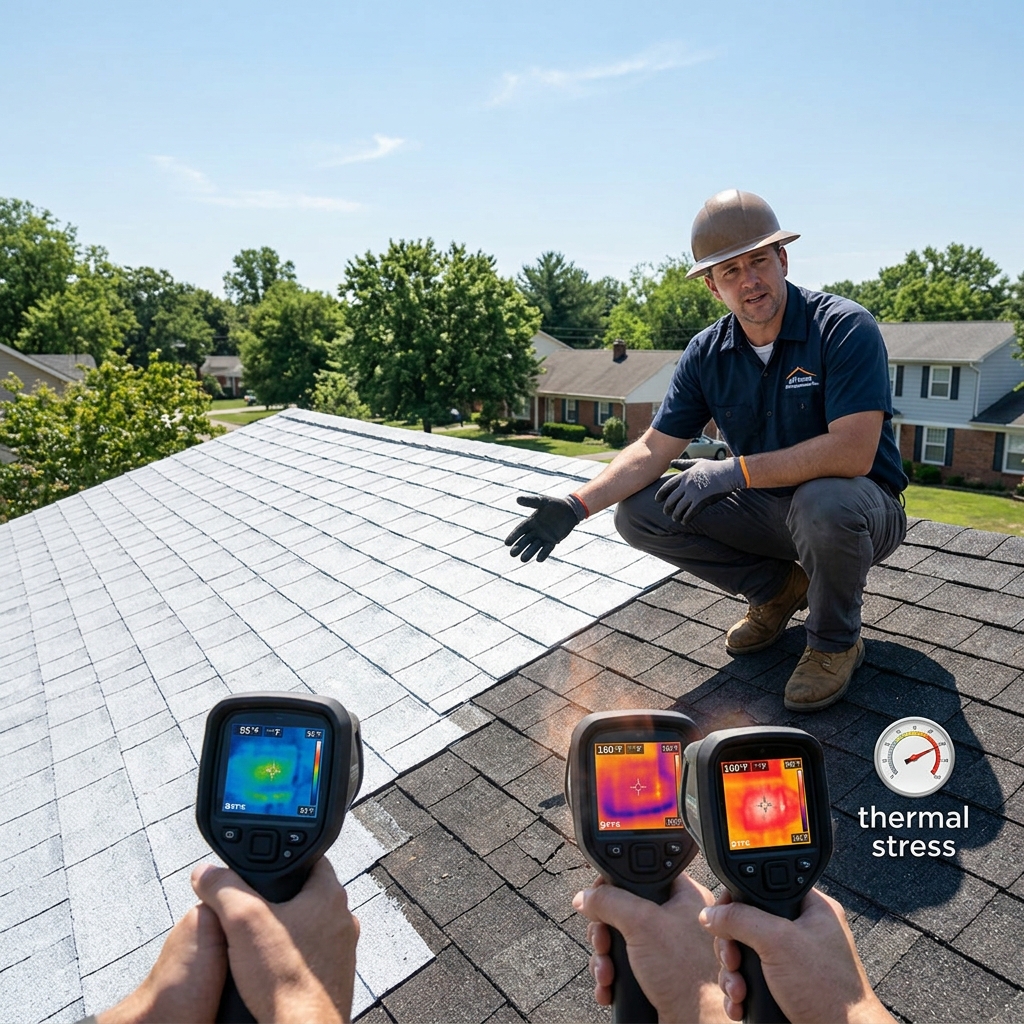
In controlled studies, cool-rated roofs maintain surface temperatures 20 to 40 degrees Fahrenheit lower than traditional dark shingles under the same sun exposure. That temperature reduction translates directly to lower attic temperatures and reduced heat transfer through ceilings into living spaces.
Attic temperatures illustrate this well. With traditional dark shingles on a sunny 95-degree day, attic temperatures can reach 140 to 160 degrees Fahrenheit. Cool-rated shingles reduce attic temperatures to 120 to 130 degrees. That 20 to 30-degree difference means your air conditioning system cools your home faster and doesn’t have to fight as hard against heat radiating through the ceiling.
The cooling energy savings vary based on several factors:
- Roof size and angle (south and west-facing roofs absorb more heat)
- Local climate and number of cooling-degree days per year
- Home insulation quality (better insulation magnifies the benefit)
- Thermostat settings and occupancy patterns
- Quality of existing air sealing in the envelope
Louisville’s climate provides favorable conditions for cool roof performance. With roughly 1,600 cooling-degree days annually, the extended cooling season justifies the energy efficiency investment. Homes with good attic insulation see efficiency gains on the higher end of the range, sometimes reaching 15 to 20 percent reductions in cooling energy consumption.
Metal roofing typically delivers slightly better cooling energy savings than cool-rated shingles due to superior reflectance and the material’s heat dissipation properties. The difference is often 3 to 5 percentage points in total cooling energy reduction, though both options substantially outperform traditional dark shingles.
One practical measure: we’ve installed roof monitoring equipment in several recent projects. Customers report measurable reductions in air conditioning cycling during peak hours and noticeably faster cooling when returning home or opening windows during cooler evening hours. These real-world observations consistently align with energy modeling predictions.
Long-Term Cooling Cost Savings Analysis
The financial argument for energy-efficient roofing relies on simple math: lower monthly cooling costs minus the upfront material premium equals net savings over your roof’s lifetime.
A typical Louisville home uses roughly 5,000 to 6,000 kilowatt-hours annually for cooling. At the current regional average of $0.13 per kilowatt-hour, that’s approximately $650 to $780 per year in pure cooling costs. A well-executed cool roof installation can reduce cooling energy consumption by 10 to 15 percent, depending on your specific home and climate zone.
That means annual cooling savings of $65 to $117 for a typical residential property. Over a 25-year roof lifespan, cumulative cooling cost savings range from $1,625 to $2,925.
The material premium for cool-rated asphalt shingles versus conventional alternatives typically runs 5 to 15 percent higher. For a 2,000 square foot roof replacement in the Louisville area, that usually means an additional $500 to $1,500 in material costs. Metal roofing carries a higher premium, typically 30 to 50 percent above asphalt shingles, adding $3,000 to $8,000 to your project cost.
Here’s where the analysis gets favorable. Even at the higher end of the premium, the cooling savings over your roof’s lifespan often recoup the investment. More importantly, you’re not spending extra money solely on energy efficiency. You’re investing in superior reflectance while maintaining all the protection, durability, and weather resistance of your primary roofing investment.
For commercial properties, the financial case strengthens considerably. A commercial building with 10,000 to 50,000 square feet of roof can accumulate $5,000 to $20,000 in annual cooling savings. Payback periods frequently fall to 8 to 12 years, after which accumulated savings grow exponentially.
We recommend requesting instant energy estimates when evaluating your roof replacement options. Our virtual consultation process includes energy modeling based on your home’s specific characteristics, giving you precise projections for your situation rather than generic averages.
Durability and Lifespan Benefits
Cool roofing materials don’t just save energy, they also outlast traditional alternatives because they experience less thermal stress.
Conventional dark shingles undergo repeated expansion and contraction cycles as they heat and cool throughout each day. On a typical summer day, a dark roof surface might swing from 85 degrees in morning shadow to 170 degrees in peak sun, then back down to 95 degrees at sunset. This constant flexing accelerates material fatigue, causes adhesive bonds to weaken, and leads to granule loss and premature deterioration.
Cool-rated shingles experience smaller temperature swings. Because they reflect more sunlight, their surface temperature climbs only to 130 to 140 degrees instead of 170. That reduced thermal cycling means less mechanical stress on the shingle material itself, less stress on the adhesive strips that hold shingles in place, and longer-lasting protective granules.
The durability advantage compounds over time. We typically observe:
- Fewer shingle splits and cracks on cool roof installations
- Better-preserved granule coverage extending into year 15 and beyond
- Reduced incidence of curling or buckling at the edges
- Extended sealed life on shingle adhesive strips
Metal roofing takes durability to another level. With proper installation, metal roofs regularly achieve 40 to 50-year lifespans, which is nearly double that of conventional asphalt shingles. The reflective properties preserve the metal finish while the material’s inherent strength resists impact damage and environmental stressors.
When you’re planning your roof replacement, consider durability as part of your total cost analysis. A cooler-running roof that lasts 30 years instead of 20 years delivers value far beyond the initial purchase price.
Why We Recommend Cool Roof Upgrades for Your Home
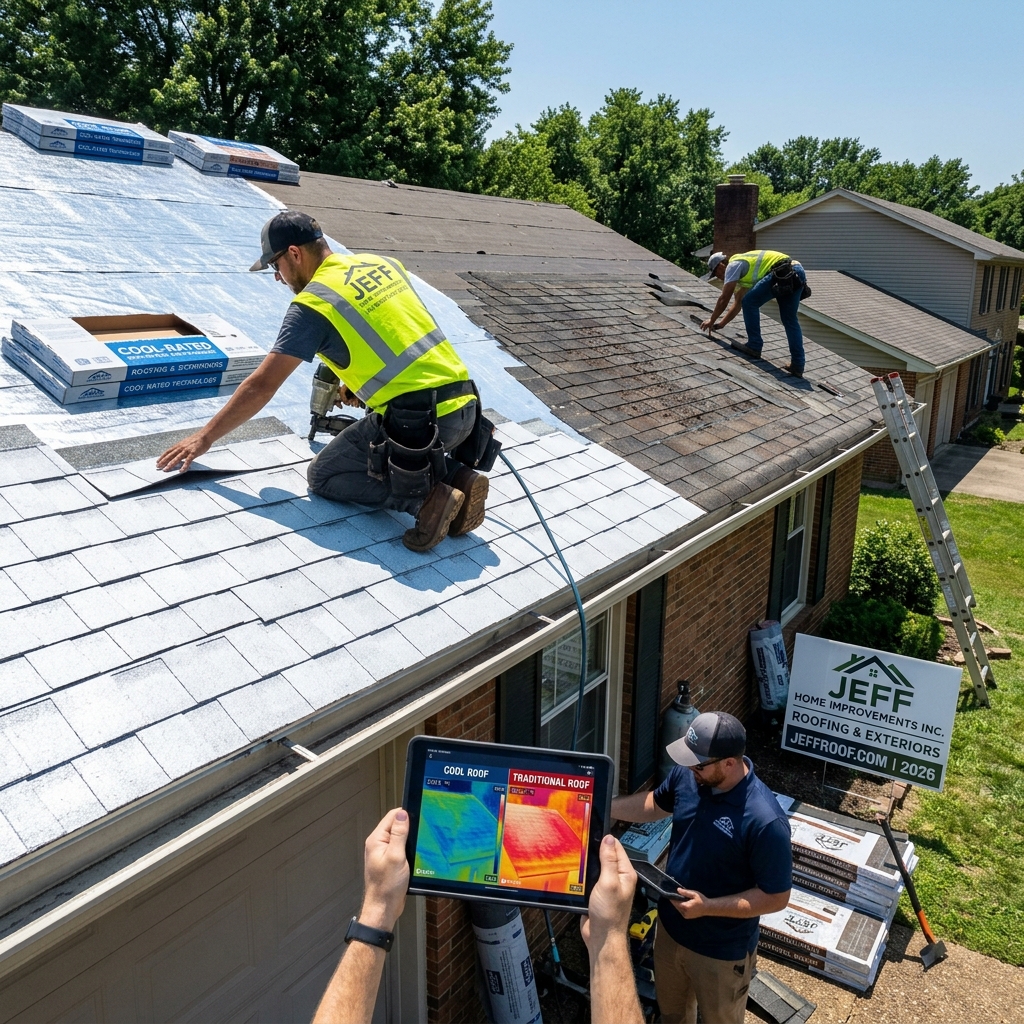
After more than three decades of roofing work across Louisville and Kentuckiana, our recommendation is straightforward: cool roofing technology makes financial and practical sense for virtually every residential property in our region.
The combination of energy savings, extended lifespan, and improved home comfort aligns with what our customers actually care about. Nobody wants higher electric bills or to replace their roof sooner than necessary. Cool roofs directly address both concerns while maintaining the appearance and protection of your home.
Kentucky’s summer climate creates ideal conditions for cool roof performance. You’re not in a heating-dominated region where roof reflectance might reduce beneficial passive solar gain in winter. The cooling season vastly outweighs heating needs, making energy-efficient roofing the clear priority.
We’ve worked with hundreds of clients who made the switch. The consistent feedback emphasizes two points: noticeably lower air conditioning bills during summer months, and confidence that their investment protects their home more effectively and longer than traditional alternatives.
As Owens Corning Platinum Preferred Contractors, we have direct access to their best-performing products and can integrate those materials into a comprehensive home exterior strategy. Cool roofing pairs beautifully with our gutter, siding, and window services to create a complete energy-efficient envelope upgrade.
The investment aligns with modern home value expectations as well. Prospective buyers increasingly recognize energy efficiency as a quality marker. A home with a newer, energy-efficient roof, quality siding, and updated windows commands better resale value than one with aging dark shingles and degraded exterior components.
Our Expert Installation Advantage
Selecting the right cool roofing material is only half the equation. Proper installation determines whether you actually realize the energy efficiency benefits promised by the manufacturer.
Many roofing contractors install cool-rated shingles using the same techniques they apply to conventional products. The problem: cool shingles require attention to detail around ventilation, underlayment selection, and flashings to optimize thermal performance. Substandard installation can reduce energy savings by 20 to 40 percent.
Our crew understands that high-performance roofing installation goes beyond nailing shingles. We evaluate your home’s existing ventilation to ensure heat can escape efficiently from the attic. We specify complementary underlayment products that work synergistically with cool shingles. We execute flashing details precisely to prevent thermal bridging at penetrations.
We also conduct virtual consultations that include a thorough assessment of your home’s current state. Before recommending any material, our team evaluates:
- Existing attic ventilation adequacy
- Roof deck condition and need for repairs
- Proper slope and drainage patterns
- Potential heat distribution issues through your home’s structure
This comprehensive approach means your cool roof installation actually performs as designed. You’re not paying for energy-efficient materials and then losing their benefits through mediocre installation practices.
Our Owens Corning Platinum Preferred Contractor certification reflects years of successful installations and customer satisfaction. We maintain this status through ongoing training, quality standards, and performance accountability.
Getting Your Energy-Efficient Roof Replacement Started
The first step is connecting with our team for a virtual consultation and instant estimate. We’ll assess your home’s current condition, discuss your energy efficiency goals, and present options with realistic cost projections and expected energy savings.
During the consultation, we’ll examine:
- Your roof’s current age and condition
- Attic insulation and ventilation quality
- Your home’s size and cooling energy patterns
- Your budget and timeline for replacement
We’ll then provide specific recommendations for cool roofing materials suited to your home and climate exposure. Our estimates include material costs, labor, and projected annual energy savings so you understand the complete financial picture.
For most properties, we can complete residential roofing replacements within 2 to 4 weeks. Storm damage repair and restoration often moves faster, depending on material availability and damage scope.
We handle the entire process: obtaining necessary permits, arranging waste removal, coordinating with your homeowners association if applicable, and ensuring final inspections verify proper installation. Your role is simple: schedule the virtual consultation, approve the proposal, and let our team handle the rest.
Ready to explore energy-efficient roofing for your Louisville home? Contact Jeff Home Improvements Inc. today to schedule your consultation. We’ll show you exactly how cool roofing technology can reduce your cooling costs, extend your roof’s lifespan, and protect your home more effectively than conventional alternatives.
Contact us today for a free in home, no obligation quote on your roof




 INDIANA
 KENTUCKY